

AI Polaroid Booth: Event Print Guide

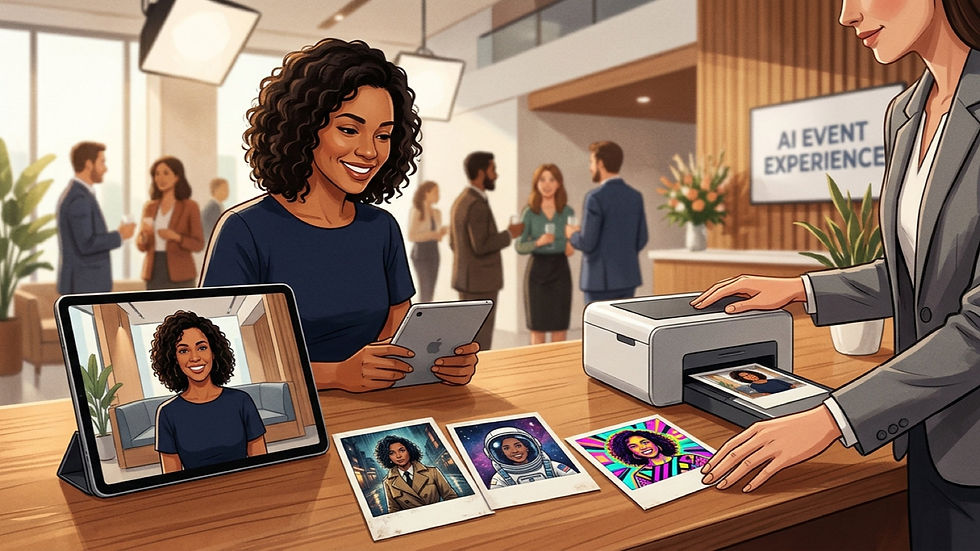
An ai polaroid booth combines an AI-styled portrait with a retro-framed print guests can take home. For an event buyer, the important choice is not the white border: it is whether the supplier can deliver an approved image, a readable physical keepsake and a workable collection process within your event's operating conditions.
Start by asking for one finished sample on the exact proposed paper, with your approved artwork and a written explanation of what the package includes. A digital preview cannot establish print quality, and a fast AI demonstration cannot establish the speed of the full guest journey.
For a branded activation, explore the PONS.ai AI photo booth experience. If you are planning in Singapore, use the Singapore AI photo booth enquiry page to discuss your date, venue, creative direction and printing requirements. Printing equipment, attendance, delivery and commercial image rights should be confirmed in the event-specific proposal rather than assumed to come with software access.
This guide is by Kelvin Tang for PONS.ai. It explains the print-first buying decisions behind this format, rather than ranking software or promising a standard rental package.
What does an ai polaroid booth actually produce?
The phrase usually describes an event experience that turns a guest photograph into a creative portrait and places it inside an instant-photo-style frame. The output might be a retro travel portrait, an illustrated character or a campaign-specific scene. The physical print makes that image something guests can carry away rather than only view on a screen.
However, three different things can be sold under similar wording: a camera using genuine instant film; a digital booth printing an ordinary photograph in a white-border layout; and a generative AI booth creating a new portrait before printing it. They do not offer the same result. Ask the supplier to identify both the image-making process and the print medium.
Polaroid is a brand, not a generic promise about the materials inside a rental. Its official Polaroid Lab product description describes turning phone photographs into real Polaroid photos using Polaroid chemistry and compatible i-Type or 600 film. That is different from sending an AI image to an event printer using conventional photo media. A retro border alone does not make a print genuine Polaroid film.
For procurement, describe the outcome precisely: “AI-generated portrait with a retro-framed paper print,” or “genuine instant-film output,” depending on what you require. This article uses Polaroid-style to describe the visual format; it does not imply endorsement, partnership or use of Polaroid equipment by PONS.ai.
Approve the output and rights before choosing features
A useful supplier question is: “Can we approve a physical sample and the complete branded guest journey before signing off the production version?” The answer should cover more than a logo pasted onto a preview. Your sample needs the final crop, border, caption, visual treatment and paper choice.
Approve the digital output and printed layout as related but separate assets. The AI image may be attractive on screen while the guest's face becomes too small inside the printed frame. A pale campaign colour may look elegant digitally but disappear on paper. A QR code that scans on a monitor may not scan when printed at the intended size.
Also establish which rights are included. Permission for a guest to keep a portrait is not automatically permission for a brand to use it in advertising. Campaign reuse, paid media, agency resale and white-label presentation may involve different terms. Ask who supplies and approves any background artwork, character references, fonts or licensed campaign elements.
This is especially important when the brief includes recognizable entertainment properties. A request for “movie-inspired” portraits should become an approved creative direction, not an assumption that famous characters, marks or likenesses can be reproduced commercially. Keep approval ownership clear between brand, agency and supplier.
Compare the formats at a glance
Choose the production method around your event's purpose. The following table compares workflows, not guaranteed supplier packages or independently tested performance.
Format | Guest receives | Useful when | Main question to resolve |
|---|---|---|---|
Genuine instant-film camera | A photograph made on instant film | The film process itself is part of the appeal | Which film, handling process and consumables are included? |
Digital booth with retro frame | A captured photo inside a designed print layout | Guests want a straightforward branded keepsake | Is the physical sample approved on the exact printer and media? |
AI-styled portrait with paper print | A transformed portrait in a print-ready design | The campaign needs a personal creative world | Can likeness, print crop and complete guest flow pass acceptance? |
AI portrait with digital delivery | A transformed image for download | Physical collection is unnecessary or impractical | How do guests retrieve their own image privately? |
PONS.ai is relevant when the creative transformation and branded experience matter. Instant Photocube is another real provider offering AI photo booth experiences: its official AI service page says prints, digital downloads or both depend on the selected package and describes professional dye-sublimation printing. That supports a specific package distinction; it does not establish equivalent service areas, pricing or performance between suppliers.
Comparable verified pricing for an identical brief is not published in the sources reviewed here. Obtain written quotations rather than treating unrelated vendor offers as a market rate. For broader supplier shortlisting, see our company-authored global AI photo booth comparison, Asia AI photo booth comparison and Hong Kong AI photo booth comparison. Those guides are starting points for questions, not independent rankings or proof that a physical printing package is included.
Design a keepsake, not a miniature poster
The print should make sense in someone's hand. Start with the person and the creative result, then decide what the border needs to communicate. A campaign name, a short event label and a modest logo may do more than a frame filled with slogans, sponsors and social instructions.
Use the exact printable area rather than a guessed screen ratio. Confirm paper dimensions, crop behaviour and any trim or margin allowance with the production supplier. Ask for the layout file or a documented template so the agency knows where text and faces can safely sit.
Keep important brand elements outside the generative part of the image wherever practical. A fixed logo or caption should remain consistent across guests instead of being recreated as part of a fantasy background. Treat the portrait as variable content and the approved branded frame as controlled artwork.
Check a representative range of portraits before signoff. Include glasses, different hairstyles, head coverings and clothing colours relevant to your audience. Agree what makes an output unacceptable and how the operator handles it. The goal is not to promise perfect results; it is to establish a sensible approval and recovery process before guests arrive.
Plan the full guest journey, including collection
A print-first activation has several stages: understand the experience, review the notice, pose, generate the image, approve or recover the result, print it and collect the correct keepsake. Some stages may overlap, but each needs an owner and a physical place.
Do not build a capacity promise from image-generation speed alone. The published Sandbox VR AI Gamer Postcards case study describes a Hong Kong Deadwood Phobia activation and roughly ten-second image processing. That is evidence for a particular digital postcard experience, not a printing benchmark or a guarantee for another event.
Run a timed rehearsal with your chosen design and equipment. Observe where people hesitate: selecting a style, reading instructions, checking the portrait or finding the collection point. Include a retry and a paper replacement in the rehearsal. These are ordinary operating tasks, not exceptional scenarios that can be ignored in a sales demo.
For a seated dinner, guests may arrive in waves before the programme and during breaks. For a trade show, demand can increase when sessions finish. Ask for a queue plan based on those arrival patterns, not only the total guest count. If digital retrieval continues while printing catches up, make that fallback clear to guests before they participate.
Specify printing, power and network requirements
Ask who brings the printer, computer or tablet, camera, lighting, paper, ribbon or other consumables. The final answer should name what is included and what the venue or organizer must supply. “Printing available” is not enough to establish an operational package.
Check the proposed location with the venue. The operator needs a stable surface, suitable power and a collection area that does not obstruct an exit or merge with another queue. Keep loose cables managed and protect prints from spills, food service and accidental collection by other guests.
Confirm network needs against the actual AI and delivery workflow. Ask what happens if connectivity becomes slow and which functions remain available. Avoid assuming an online generation experience can work offline simply because the camera can still capture photographs. A fallback may mean digital delivery later, a conventional photograph or temporarily pausing participation; approve it in advance.
Prepare a replenishment plan. Who watches consumable levels, clears rejected prints and resolves a jam? Who can authorize a change if demand exceeds the included print allocation? The answer should be part of the production brief, especially if the event runs across multiple sessions or days.
Build a clear quote request
Send the same written brief to each supplier so differences in quotations become visible. Include the event date, city, venue, operating window, expected guest arrival pattern, required image styles, print format and whether digital retrieval is also needed.
Separate creative preparation from on-site operations. You may need concept development, style testing, brand-frame design and sample approval before installation begins. Clarify how many revision rounds are included and when the final creative direction must be approved. Do not assume a change made during an event is commercially or technically equivalent to an approved pre-event adjustment.
Request an itemized answer covering:
Equipment, delivery, installation and removal responsibilities.
Operator attendance, breaks and support arrangements.
Included prints, replacements, retries and consumable replenishment.
Image creation, frame design and approval revisions.
Digital delivery, retention and any reporting requirements.
Travel, venue access, taxes, overtime and exclusions.
Do not compare a software-only licence with a staffed print activation as if they were the same purchase. For San Francisco planning, use the San Francisco AI photo booth enquiry page to discuss the complete local scope. A market page is an enquiry route, not proof that equipment, staff or travel are available for every date.
Choose a concept that fits the event
For a product launch, the print can place guests inside an approved campaign world. Keep the creative connection specific: the visual treatment should relate to the product story without suggesting a product endorsement by the guest. Let the frame carry the factual campaign name while the portrait supplies the personal element.
For an employee celebration, a collectible portrait can work without becoming a lead-generation exercise. Participation should feel optional, and internal distribution needs its own approval. Avoid turning a light entertainment experience into a public staff directory or an automatic marketing subscription.
For a public exhibition or visitor attraction, the handover matters as much as the image. Make it obvious how the person collects the correct print, whether another copy is available and what happens to uncollected photographs. Consider whether a bag, sleeve or nearby collection table is appropriate for your venue.
For a wedding or private party, decide whether the emphasis is a simple memory or an elaborate transformation. An ordinary retro-framed photo can be the better choice if guests mainly want a recognizable group portrait. AI is useful when it serves the intended experience, not simply because the event needs a technology label.
These are planning scenarios, not claims that PONS.ai has delivered each format in every market.
What real PONS.ai evidence tells a print buyer
The Sandbox VR immersive entertainment case study describes guests becoming characters within the Deadwood Phobia world in Hong Kong. Its useful lesson is the creative connection between an existing experience and a personalized takeaway.
For a print brief, carry that principle forward: choose an image concept guests understand because it belongs to the occasion. Then validate the additional print stage separately. The source documents digital postcards; it does not establish a physical Polaroid installation, a verified print count or a particular printer configuration.
Do not turn qualitative case-study language into a projected business result. A memorable image may support sharing, but the number of people who collect a print is not the number who post it. Neither figure is automatically a qualified enquiry, sale or booking.
This distinction helps buyers ask better questions. Instead of demanding a universal “engagement rate,” define which actions the activation should support and which can actually be measured with permission. Creative evidence and operational acceptance are more useful than an unsupported promise about return on investment.
Set practical privacy and image-use boundaries
Explain the experience before capture in language guests understand. State what the photo is used for, how outputs are delivered, whether contact details are needed and how someone can ask for removal. The appropriate notice and legal basis depend on the event and jurisdiction; have the responsible organizer approve them.
Keep image delivery separate from unrelated marketing choices. A person who wants a printed portrait should not be led to believe that a newsletter subscription is necessary unless the event's approved design genuinely requires it and the arrangement is made clear. Do not use participation itself as proof of consent for advertising reuse.
Ask the supplier for its documented handling process rather than assuming a standard retention period or certification. Cover original photographs, generated images, print queues, contact details and operator access. Shared screens and collection tables also matter: the guest experience can expose a portrait even when the underlying account is protected.
For children or sensitive corporate audiences, agree the relevant guardian, organizer and distribution requirements before launch. Provide a straightforward way to decline. An alternative activity or ordinary photograph may be more appropriate for someone uncomfortable with a creative transformation.
Run a print acceptance test before event day
Test a finished sample under lighting similar to the event. Check face detail, skin tones, dark areas, border alignment and whether the guest can read the event label comfortably. Inspect the same file digitally and physically; neither should be treated as a substitute for the other.
Scan any approved QR code from the actual print using more than one phone. Confirm it reaches the intended destination and does not expose another guest's portrait or require an unexplained login. Check how retrieval works after the event, including the period for which the link remains available.
Rehearse an unsuitable result, duplicate request and printer interruption. Agree whether the operator may regenerate, whether a guest can choose a non-AI photograph and how copies count against the included allowance. Record who can make decisions when the creative approver is no longer on site.
Finally, sign off one reference print and preserve the associated layout. This becomes the production target. If a last-minute sponsor or caption changes, check the print again instead of assuming the layout remains safe. Small design edits can affect the crop, contrast and available face area.
How should you measure the activation?
Define success before choosing a dashboard. An employee celebration may prioritize a smooth experience and acceptable keepsakes. A brand activation may also need opt-in digital retrieval, an attributable enquiry route or a follow-up invitation. Each is a different objective.
Keep counts distinct: sessions started, usable images generated, prints handed over, digital retrievals and permissioned enquiries. If the supplier cannot measure an action reliably, label it unknown. Do not report a share-button tap as a verified public post or a form submission as a qualified booking.
Include operational observations in the debrief. Note periods of heavy demand, common guest questions, recovery incidents and any stock replenishment. These details help improve the next event even when commercial attribution is incomplete.
Avoid invented financial returns. If you calculate cost per collected print or per verified enquiry, state which costs and events are included. Report what happened rather than presenting every improvement as the effect of AI alone.
Is an AI Polaroid-style booth the same as genuine instant film?
No. A retro-framed AI portrait printed on conventional photo media is different from a photograph made on genuine instant film. Ask the supplier to identify the paper or film, equipment and process in writing.
Can guests receive both a print and a digital portrait?
They can if both are included in the approved workflow and quotation. Confirm whether the digital version uses the same crop and branding, how guests retrieve it and whether contact details are optional or required for that delivery method.
How quickly will each guest receive the finished print?
The answer depends on the complete tested journey, not image generation alone. Capture, creative processing, guest decisions, print queuing and collection all affect waiting time. Request a rehearsal with the actual design and equipment rather than accepting an unrelated speed claim.
What should an event planner approve before booking?
Approve a representative portrait, an actual print, the branded layout, usage rights, privacy notice, recovery process and itemized operating scope. Confirm event-specific availability and responsibilities before treating a creative demonstration as a bookable local package.
Plan your print-first demo
Bring your event city, date, venue, audience and desired print format to the first discussion. Ask to see how your approved creative world becomes a portrait, how that portrait fits the physical frame and how a guest collects the finished result.
PONS.ai can discuss the creative brief and proposed activation scope without assuming that a retro border, software licence or historical digital case study already answers your printing requirements. The strongest demo proves the keepsake and the workflow together.
Book a demo with PONS.ai


Comments