top of page
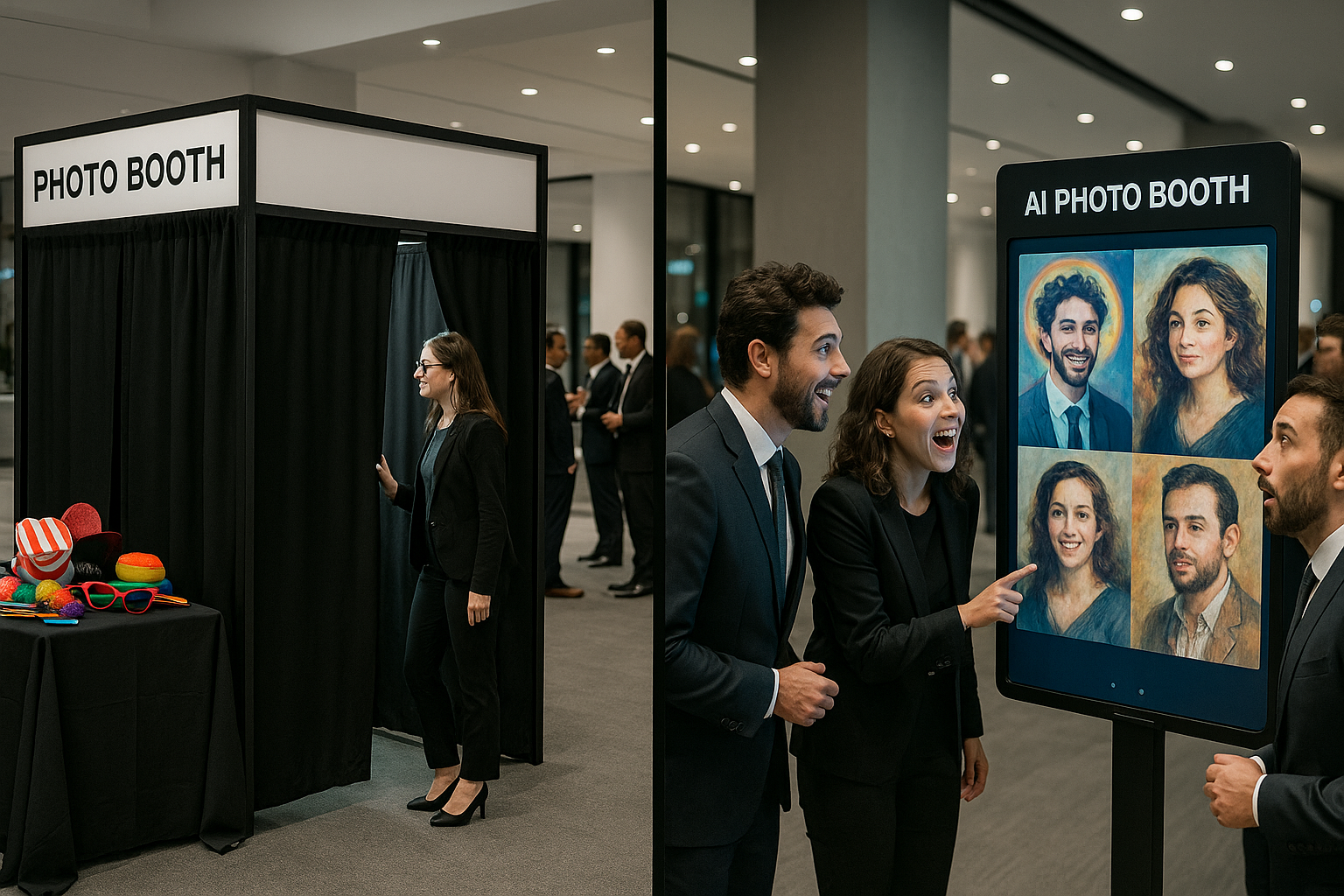
AI photo booth vs traditional photo booth comparison showing modern AI-generated portraits alongside classic photo strips at a corporate event

The Photo Booth Evolution: From Film Strips to AI Art

The photo booth has been an event staple since the 1920s. What began as coin-operated machines printing black-and-white film strips in train stations has evolved into one of the most powerful engagement tools in modern event marketing. But with the arrival of generative AI, the gap between traditional photo booths and AI-powered alternatives has become a canyon.

If you are planning a corporate event, brand activation, wedding, or trade show in 2026, the choice between a traditional photo booth and an AI photo booth will shape your guest experience, social media reach, and event ROI. Here are the 10 key differences every event planner needs to understand.

1. Output Quality: Filtered Snapshots vs AI-Generated Art

Traditional photo booths capture standard digital photos, then apply basic filters — think sepia tone, black-and-white, or brightness adjustments. The result is a pleasant but predictable snapshot that looks like every other photo booth photo strip.

AI photo booths fundamentally transform the image. Using generative AI models, they turn a simple selfie into a fully rendered piece of digital art — oil paintings, anime characters, cyberpunk portraits, pop art, watercolour illustrations, and hundreds of other styles. At PONS.ai, our proprietary AI engine generates these transformations in approximately 10 seconds, producing output that guests genuinely want to share.

The difference: A traditional photo booth gives you a memory. An AI photo booth gives you a collectible.

2. Personalization: One-Size-Fits-All vs Infinite Customization

Traditional booths offer a fixed set of options. You choose a backdrop, a frame design, maybe a colour filter, and every guest gets the same combination. Customization typically means swapping physical props — wigs, glasses, silly hats — which degrade over the course of a long event.

AI photo booths deliver true personalization at scale. Each guest receives a unique, AI-generated image tailored to the event theme, the brand's visual identity, and even the individual's preferences. At a PONS.ai activation for Starbucks across APAC, each guest received AI-generated portraits styled to match Starbucks' seasonal campaign — no two outputs were identical, yet every image was unmistakably on-brand.

The difference: Traditional booths customize around the booth. AI booths customize around the guest.

3. Brand Integration: Logo Overlays vs Full Creative Control

With traditional photo booths, brand integration usually means adding a logo to the photo strip border, a branded backdrop, or a custom frame. The branding exists alongside the photo but does not shape the creative itself.

AI photo booths embed the brand into the actual image generation. The AI model can be trained or prompted to incorporate brand colours, visual motifs, mascots, product imagery, and campaign themes directly into the generated artwork. When PONS.ai activated at the LONGINES International Jockeys' Championship, every AI-generated portrait incorporated the brand's equestrian elegance and signature blue, gold, and white palette — the brand was not overlaid on the photo but woven into the art itself.

The difference: Traditional branding is decorative. AI branding is generative.

4. Guest Throughput: Queues vs Volume
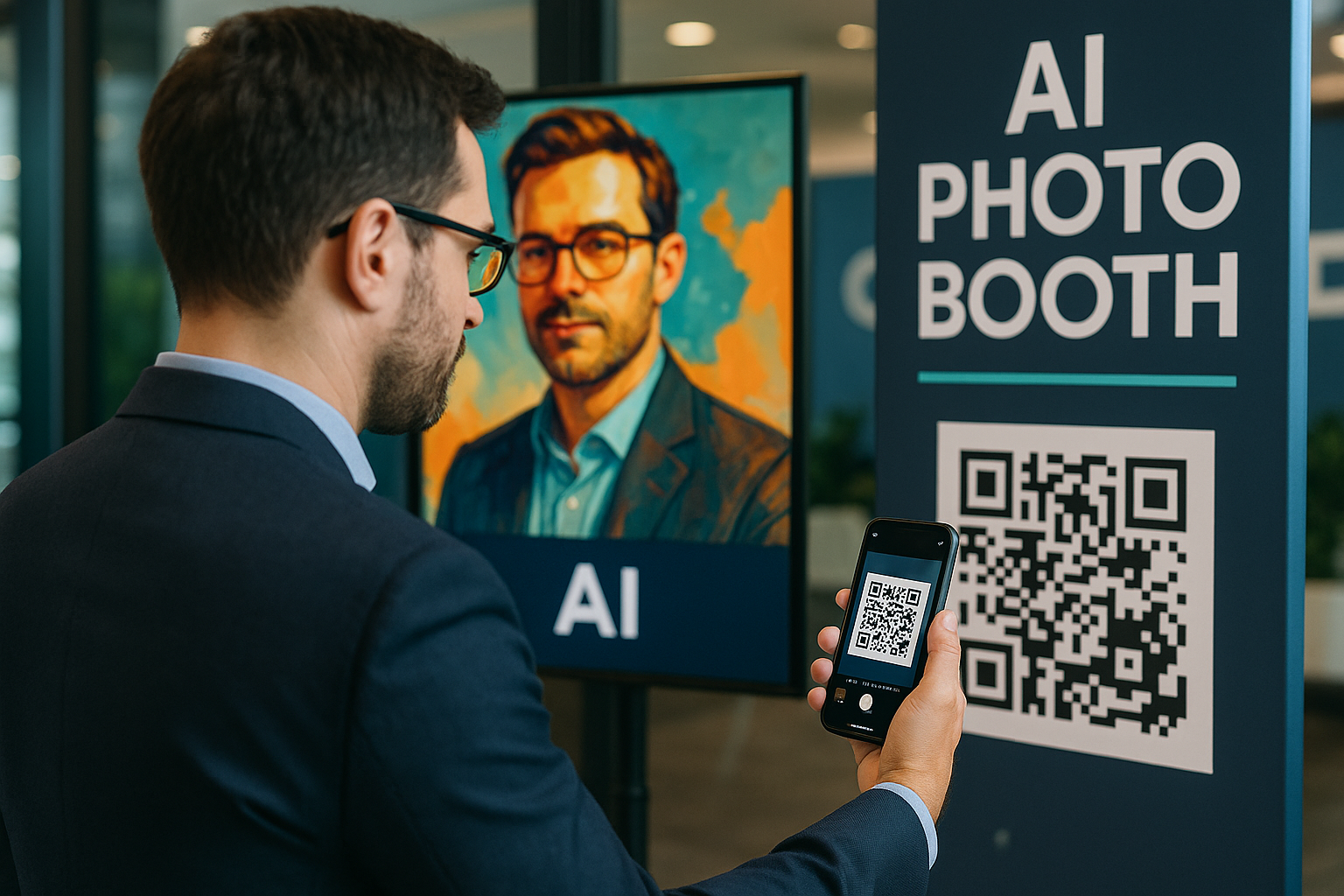
Event attendee using QR code to instantly share AI photo booth portrait on smartphone

Traditional photo booths typically process 3–5 groups per 10-minute window. Guests enter, pose, wait for prints, collect their strip, and exit. With enclosed booths, only 2–4 people fit at a time. On a busy night, this creates long queues — and many guests simply walk past rather than wait.

AI photo booths dramatically increase throughput. A single PONS.ai station can process 60–100+ guests per hour because the workflow is streamlined: take a photo, select a style, receive your AI-generated image via QR code in under 15 seconds. No printing delays, no physical bottleneck. At the BLAST Premier esports tournament, PONS.ai processed over 800 unique portraits in a single day across just two stations.

The difference: Traditional booths serve dozens. AI booths serve hundreds — at the same event.

5. Content Volume: 3–4 Photos vs 10–50+ Per Guest

A traditional photo booth session yields 3–4 nearly identical photos on a single strip. Maybe you get a goofy face, a serious face, and a group squeeze. That is the extent of the content.

AI photo booths multiply content exponentially. Each guest can generate multiple AI artworks in different styles — a corporate headshot, a fantasy portrait, a pop art version, an anime transformation. At corporate activations powered by PONS.ai, guests typically generate 8–15 unique images per visit, and the most engaged users create 30+ variations. This content cascade feeds social media, internal communications, and follow-up campaigns for weeks after the event.

The difference: Traditional booths produce souvenirs. AI booths produce content libraries.

6. Sharing and Distribution: Physical Prints vs Instant Digital

Traditional photo booths produce physical prints — photo strips, 4×6 prints, or occasionally Polaroid-style outputs. Some modern traditional booths add email or SMS delivery, but the primary output remains a tangible keepsake. These prints rarely make it to social media because scanning a photo strip is an extra step most guests skip.

AI photo booths are digital-native. Every image is delivered instantly via QR code, shareable to Instagram, TikTok, WhatsApp, WeChat, and LinkedIn in seconds. PONS.ai's platform tracks that over 78% of guests share their AI-generated portraits on at least one social platform within 24 hours of the event. That organic sharing turns every guest into a brand ambassador.

The difference: Traditional outputs stay in wallets. AI outputs go viral.

7. Data and Analytics: Guesswork vs Real-Time Insights

Traditional photo booths generate almost zero data. You know how many prints were made, and that is about it. There is no guest identification, no engagement metrics, no sharing analytics, and no lead capture unless you manually add a guestbook.

AI photo booths are data engines. PONS.ai's analytics dashboard tracks total generations, unique users, average time per session, peak usage periods, most popular styles, social sharing rates, QR code scan rates, and email opt-in conversions. At the KPMG anniversary celebration, this data revealed that the AI photo booth achieved a 73% participation rate among all event attendees — actionable intelligence for planning future activations.

The difference: Traditional booths count prints. AI booths measure engagement.

8. Setup and Logistics: Heavy Hardware vs Lean Deployment

A traditional enclosed photo booth is a substantial piece of hardware. It typically requires a dedicated 8×8 foot space, power supply, printer maintenance, prop management, backdrop installation, and often a dedicated attendant. Transport, setup, and teardown can take 2–3 hours each way.

AI photo booths run lean. A PONS.ai activation requires a tablet or touchscreen, a camera, stable internet, and a compact branded enclosure. Total footprint: as small as 4×4 feet. Setup time: under 30 minutes. The system runs unmanned, auto-recovers from errors, and needs zero consumables (no ink, no paper, no props to replace). For the Sandbox VR activation, PONS.ai deployed a fully operational AI photo booth station within 20 minutes of arriving on-site.

The difference: Traditional booths need a crew. AI booths need a power outlet.

9. Cost Structure: Per-Event Rental vs Scalable Investment

Traditional photo booth rentals typically cost USD $400–$1,500 per event for 2–6 hours. Add-ons like custom backdrops, extra prints, attendant fees, and travel charges push costs higher. Every event is a new rental expense, and the cost scales linearly — two events means double the cost.

AI photo booth pricing follows a different model. While initial setup costs may be higher, the per-event marginal cost drops significantly at scale. PONS.ai offers both per-event activations and enterprise licensing for brands that run frequent campaigns. For a brand running 10+ activations per year, the cost per engagement with an AI photo booth can be 60–70% lower than equivalent traditional booth rentals, while generating 5–10x more content and measurably higher guest engagement.

**Cost Factor** | **Traditional Photo Booth** | **AI Photo Booth (PONS.ai)**

Typical per-event cost | $400–$1,500 | Custom quote (volume discounts)

Attendant required | Yes (1–2 staff) | No (unmanned operation)

Consumables per event | $50–$150 (ink, paper, props) | $0

Content per guest | 3–4 photos | 10–50+ AI artworks

Social shares per event | Low (~5–10%) | High (~78% share rate)

Data/analytics included | No | Yes (full dashboard)

Setup time | 2–3 hours | Under 30 minutes

10. Future-Proofing: Static Technology vs Continuous Innovation
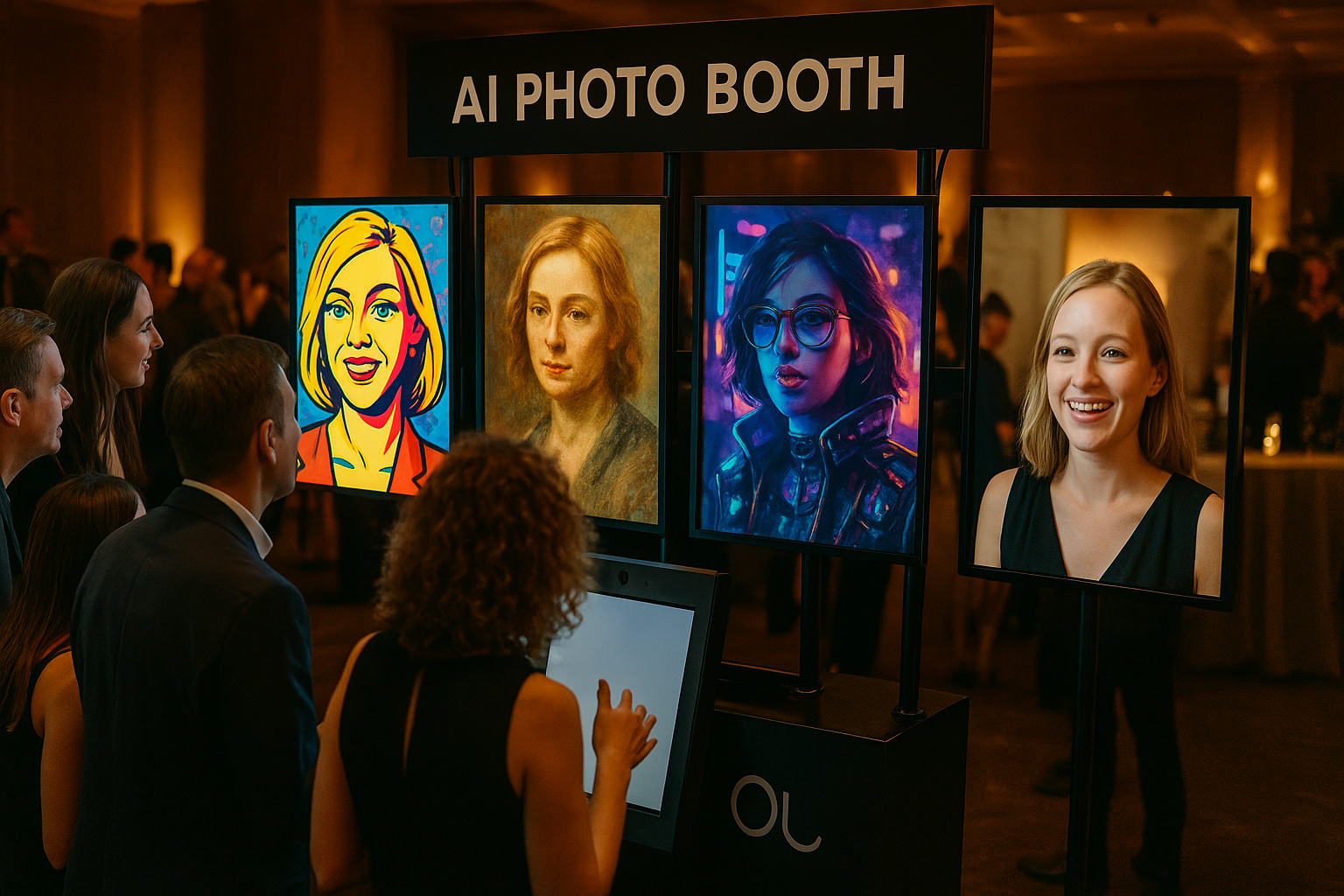
AI photo booth displaying multiple generative art styles at corporate gala event

Traditional photo booths have reached a technological plateau. The core technology — camera, printer, backdrop — has not fundamentally changed in 15 years. Upgrades mean buying new hardware: a better camera, a faster printer, a fancier enclosure. Each upgrade is a capital expenditure that depreciates immediately.

AI photo booths improve through software updates. PONS.ai's platform receives regular model upgrades that improve image quality, add new artistic styles, and expand capabilities — all without changing hardware. In 2025, PONS.ai added real-time video transformation, multi-person group portraits, and brand-specific fine-tuned models. These updates were deployed to all active installations simultaneously, at zero additional cost to clients.

The difference: Traditional booths depreciate. AI booths appreciate.

Side-by-Side Comparison: 10 Differences at a Glance

**Feature** | **Traditional Photo Booth** | **AI Photo Booth**

Output type | Standard filtered photo | AI-generated artwork

Personalization | Fixed backdrops and props | Infinite AI styles per guest

Brand integration | Logo overlay on border | Brand woven into the art itself

Throughput | 20–30 guests/hour | 60–100+ guests/hour

Content per guest | 3–4 identical photos | 10–50+ unique artworks

Sharing method | Physical print | Instant digital via QR code

Data and analytics | Print count only | Full engagement dashboard

Setup time | 2–3 hours | Under 30 minutes

Staffing | 1–2 attendants required | Unmanned operation

Technology lifecycle | Hardware-dependent upgrades | Continuous software updates

Which One Should You Choose?

The honest answer: it depends on your event goals.

Choose a traditional photo booth if:

  • You want a nostalgic, retro experience as the primary appeal

  • Physical photo strip souvenirs are essential (e.g., vintage-themed weddings)

  • Your budget is under $500 for a single small event

  • You do not need digital content or social media amplification

Choose an AI photo booth if:

  • Guest engagement and participation rates are priority metrics

  • You need branded content that guests will share organically on social media

  • Data and analytics matter for post-event reporting and ROI measurement

  • You are running multiple activations and need scalable technology

  • You want a "wow factor" that differentiates your event from every other gathering

For enterprise brands, agencies, and event planners who need measurable results, the shift toward AI-powered photo experiences is not a trend — it is a structural change in how events generate value. The traditional photo booth served its era well. The AI photo booth is built for what comes next.

Frequently Asked Questions

Can an AI photo booth also print physical photos?

Yes. Most AI photo booth platforms, including PONS.ai, offer optional print modules that produce high-quality prints of the AI-generated artwork. You get the best of both worlds — digital shareability plus a tangible takeaway.

Is an AI photo booth harder to operate than a traditional one?

The opposite. Traditional booths require attendants to manage props, refill printers, and troubleshoot jams. PONS.ai's AI photo booth runs autonomously with a self-service touchscreen interface. Event staff can focus on other priorities.

How long does each AI photo booth session take?

A typical PONS.ai session — from photo capture to receiving the AI-generated image — takes approximately 10–15 seconds. Traditional booths average 2–3 minutes per session including printing time.

Do AI photo booths work without internet?

PONS.ai offers both cloud-based and edge-processing configurations. For venues with limited connectivity, on-premise processing ensures the experience runs smoothly without relying on internet speed.

What about data privacy with AI photo booths?

PONS.ai is built with enterprise-grade security. Guest photos are processed and delivered but never stored long-term without explicit consent. The platform complies with GDPR, PDPO (Hong Kong), and other regional data protection regulations. All data is encrypted in transit and at rest.

Book a demo with PONS.ai to see the difference firsthand and discover which solution fits your next event.

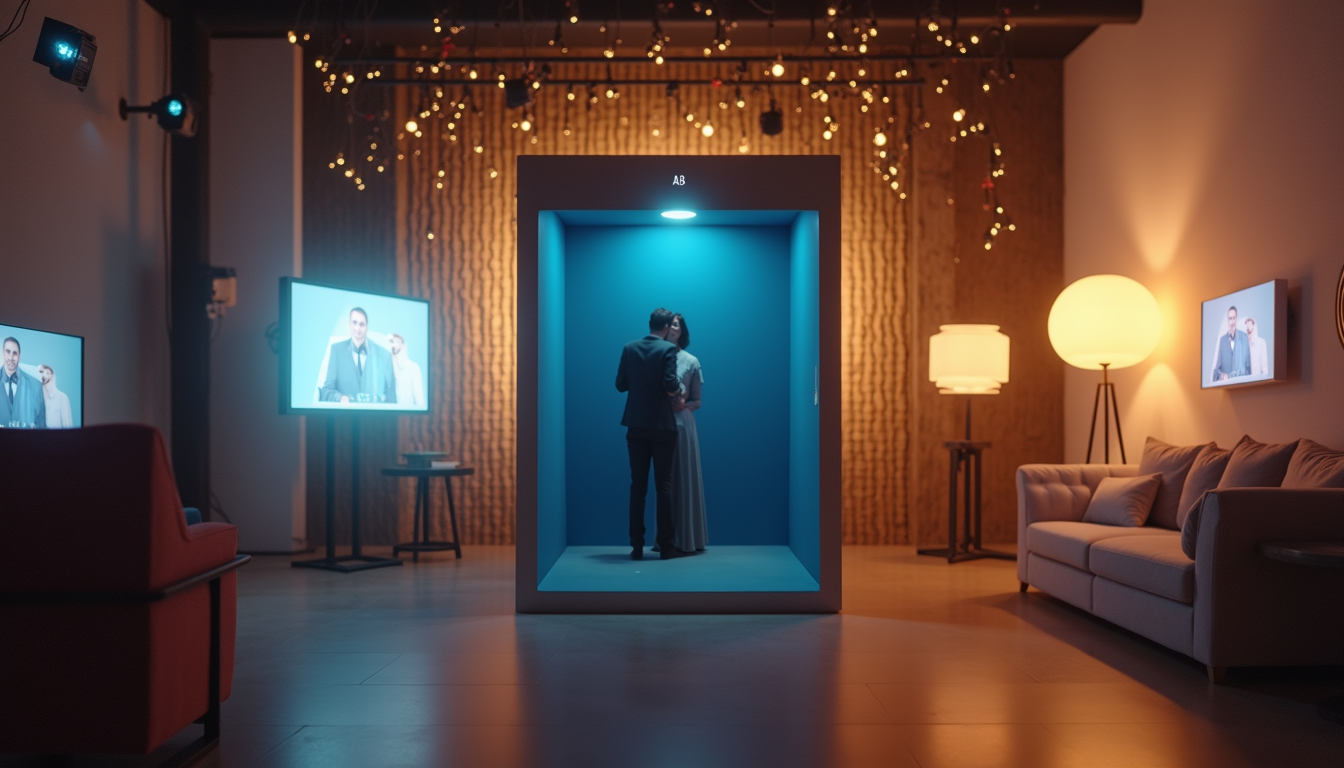
AI photo booth activation at a Chicago corporate event with guests using generative AI technology by PONS.ai

Chicago is not just a convention city — it is the convention city. With McCormick Place welcoming 2.6 million visitors annually, over 2,000 meetings booked each year generating $4.8 billion in economic impact, and a hospitality sector producing $20.6 billion for the local economy, the Windy City sits at the epicentre of America's Midwest event industry.

For event planners, brand managers, and marketing agencies operating in the US Midwest, that means one thing: the competition for attendee attention is fierce. And in 2026, the brands winning that competition are the ones deploying AI photo booths as their secret weapon for engagement, data capture, and social amplification.

This guide breaks down everything you need to know about bringing an AI photo booth to your next Chicago event — from venue logistics and pricing to ROI benchmarks and real-world activations.

What Is an AI Photo Booth?

An AI photo booth uses generative AI to transform guest photos in real time. Unlike traditional photo booths that apply static filters or overlays, an AI photo booth can place guests into entirely new scenes, transform their appearance to match a brand theme, or generate custom artistic renditions — all in approximately 10 seconds per image.

The result? Every guest walks away with a unique, share-worthy image that carries your brand's visual identity. At PONS.ai, we have processed millions of AI-generated photos across corporate events, brand activations, product launches, and experiential campaigns since 2021.

Why Chicago Event Planners Need AI Photo Booths in 2026

Chicago's event landscape has specific characteristics that make AI photo booths particularly effective:

McCormick Place and the Trade Show Circuit

McCormick Place is one of North America's largest convention centres, hosting 12 of the Top 250 trade shows annually. Events like ProMat (50,000+ attendees), the AHR Expo (48,000+ attendees), and ASCO regularly draw massive crowds. At this scale, traditional booth engagement tactics — brochures, product demos, giveaways — struggle to cut through the noise.

An AI photo booth creates a destination within your booth. Attendees queue up for the experience, spend 2-3 minutes interacting with your brand, and leave with a digital asset they will share on LinkedIn, Instagram, and internal Slack channels. PONS.ai has seen 3x average dwell time at booths equipped with AI photo experiences compared to standard setups.

Corporate Event Density

Chicago leads the US for meetings and events by volume. National associations, pharmaceutical companies, healthcare organisations, and financial services firms all converge here. These are high-value B2B audiences where every interaction matters.

AI photo booths deliver measurable engagement data: email addresses, social handles, sharing rates, and time-on-station metrics. For B2B marketers, this turns a fun activation into a lead generation machine.

Chicago's Tech-Forward Venues

The city's venue infrastructure is catching up to its tech-savvy audience. Moonlight Studios offers built-in LED walls and production studios. Convene locations at Willis Tower and 311 West Monroe provide purpose-built corporate event spaces. LondonHouse Chicago delivers state-of-the-art hybrid event technology. These venues are primed for AI-powered activations.

Top Chicago Venues for AI Photo Booth Activations

Choosing the right venue directly impacts your AI photo booth's effectiveness. Here are the top choices for different event types:

Venue | Best For | Capacity | AI Photo Booth Notes

McCormick Place | Trade shows, conventions | 600,000+ sq ft | Multiple booth zones, high foot traffic, power/internet infrastructure ready

Navy Pier | Brand activations, launches | Varies by hall | Iconic lakefront backdrop, excellent for outdoor/indoor hybrid setups

Moonlight Studios | Immersive experiences | Up to 1,000 | Built-in LED walls complement AI photo booth visuals

Convene Willis Tower | Corporate meetings | Up to 300 | Premium B2B environment, in-house AV support

Art Institute of Chicago | Gala events, fundraisers | Varies | Elegant setting for luxury brand AI activations

The Geraghty | Large corporate events | Up to 1,200 | Industrial-chic aesthetic, flexible floor plans

Morgan Manufacturing | Product launches | Up to 1,500 | Open floor plan ideal for multi-station AI photo setups

How AI Photo Booths Work at Scale: The Chicago Trade Show Example

Running an AI photo booth at McCormick Place for a 3-day trade show requires different planning than a 200-person corporate dinner. Here is how PONS.ai approaches large-scale activations:

Pre-Event Setup (1-2 Weeks Before)

  • Custom AI model training on brand assets, colour palette, and theme

  • Template creation: 3-5 distinct AI transformation styles per client

  • Hardware configuration: iPad stations, lighting rigs, backdrop elements

  • Network testing: dedicated WiFi or hardwired connection for sub-10-second generation times

On-Site Execution

  • Setup time: approximately 2 hours for a standard single-station booth

  • Throughput: 80-120 guests per hour per station

  • Multi-station configurations: up to 4 stations for high-traffic events

  • On-site PONS.ai technician manages the experience end-to-end

Real-Time Data Capture

  • Email collection at point of interaction (opt-in)

  • QR code delivery for instant social sharing

  • Analytics dashboard showing engagement rates, peak times, and sharing metrics

  • Post-event data export compatible with major CRM platforms (Salesforce, HubSpot)

AI Photo Booth Pricing for Chicago Events

Pricing for AI photo booths in Chicago varies based on event duration, customisation level, and number of stations. Here is a realistic benchmark:

Package | Duration | Stations | Includes | Price Range

Essential | 2-4 hours | 1 | 2 AI templates, digital delivery, on-site tech | $2,500-$4,000

Professional | Full day | 1-2 | 4 AI templates, branded UI, analytics dashboard, instant prints | $5,000-$8,000

Enterprise | Multi-day | 2-4 | Custom AI model, unlimited templates, dedicated team, CRM integration | $10,000-$25,000+

Trade Show Special | 3-day show | 2-3 | High-throughput config, lead capture, daily analytics reports | $12,000-$20,000

For McCormick Place events specifically, factor in additional costs for union labour, drayage, and venue-specific electrical requirements. PONS.ai handles all coordination with the venue's exhibition services team.

Real-World ROI: AI Photo Booths at Midwest Corporate Events

The question every Chicago event planner asks: does it actually deliver ROI?

Here are the benchmarks from PONS.ai activations:

Engagement Metrics

  • Average dwell time at AI photo booth: 3.2 minutes (vs 45 seconds for standard booth visit)

  • Photo share rate: 68% of guests share their AI photo on at least one social platform

  • Email opt-in rate: 72% when offered instant delivery of their AI photo

  • Return visits: 23% of trade show attendees return to the booth with colleagues

Lead Generation Impact

  • Average qualified leads per day at trade shows: 180-250 per station

  • Cost per lead: $12-$35 (compared to $50-$150 for traditional trade show lead gen)

  • Post-event email open rate for AI photo follow-ups: 45% (industry average: 21%)

Brand Amplification

  • Average social impressions per event: 15,000-50,000 from guest shares alone

  • Earned media value: 3-5x the activation cost for enterprise events

  • Brand recall: 78% of attendees remember the brand 30 days post-event (vs 12% for standard booth visits)

Chicago's Event Calendar: When to Deploy AI Photo Booths

Timing your AI photo booth activation to coincide with Chicago's peak event seasons maximises impact:

Peak Convention Season (March-June)

  • ProMat, NRA Show, ASCO, TECHSPO Chicago

  • Highest trade show foot traffic

  • Book 6-8 weeks in advance

Corporate Event Season (September-November)

  • Fall galas, annual meetings, holiday parties

  • Strong demand for branded experiences

  • Premium pricing period

Summer Activation Season (June-August)

  • Outdoor brand activations, festivals, product launches

  • Navy Pier and outdoor venues in high demand

  • Ideal for consumer-facing AI photo experiences

Year-Round Opportunities

  • Pharma and healthcare conferences (continuous)

  • Financial services events at the Chicago Board of Trade area

  • Tech meetups and startup events in Fulton Market district

How PONS.ai Differs from Local Chicago Photo Booth Providers

Chicago has a crowded photo booth market. Here is what separates an enterprise AI photo booth solution from a standard rental:

Feature | Traditional Chicago Rentals | PONS.ai AI Photo Booth

Technology | Static filters, green screen | Generative AI transformation

Customisation | Logo overlay, backdrop colour | Custom AI model trained on your brand

Output quality | Standard photo with filter | Unique AI-generated artwork per guest

Data capture | Basic email collection | Full analytics: dwell time, share rate, demographics

Enterprise security | Varies | SOC 2 compliant, on-premise processing available

Scalability | 1-2 stations | Up to 4 stations, 120 guests/hour each

Branding depth | Surface-level | Every AI output embeds brand DNA

Post-event value | Photos forgotten in camera roll | Shareable content that drives ongoing social impressions

Setting Up Your AI Photo Booth in Chicago: A Step-by-Step Guide

Step 1: Define Your Objectives

Are you capturing leads at a McCormick Place trade show? Building brand awareness at a Navy Pier activation? Entertaining guests at a corporate gala? Your goal determines the AI templates, station count, and data capture setup.

Step 2: Choose Your AI Experience

PONS.ai offers multiple activation types:

  • AI Face Swap: Transform guests into themed characters (superheroes, historical figures, brand mascots)

  • AI Scene Generation: Place guests in custom environments (your product showroom, fantasy landscapes, branded worlds)

  • AI Art Style Transfer: Convert photos into oil paintings, comic book art, or brand-specific illustration styles

  • AI Video Generation: Short 5-second AI-generated clips for social media sharing

Step 3: Plan Your Logistics

  • Confirm venue power requirements (standard 110V outlet per station)

  • Test WiFi or arrange hardwired internet (minimum 50 Mbps upload for cloud processing)

  • Allocate floor space: 8x8 feet minimum per station including backdrop

  • Schedule setup and teardown windows with venue management

Step 4: Brief the PONS.ai Team

Share your brand guidelines, event theme, target audience profile, and KPIs. PONS.ai's creative team designs custom AI templates 1-2 weeks before the event.

Step 5: Activate and Measure

On event day, the PONS.ai on-site team handles everything. Post-event, you receive a comprehensive analytics report with all captured leads and engagement data.

Frequently Asked Questions

How far in advance should I book an AI photo booth for a Chicago event?

For trade shows at McCormick Place, book 6-8 weeks in advance. For corporate events, 3-4 weeks is typically sufficient. Peak season (March-June and September-November) requires earlier booking.

Can AI photo booths work in McCormick Place's exhibition halls?

Yes. PONS.ai has experience with major convention centres and works directly with exhibition services teams to meet all power, internet, and union labour requirements.

What internet speed does an AI photo booth need?

A minimum of 50 Mbps upload speed for cloud-based processing. For on-premise processing (available with Enterprise packages), standard venue WiFi is sufficient as all generation happens locally.

How do AI photo booths handle data privacy?

PONS.ai offers enterprise-grade data handling with SOC 2 compliance, optional on-premise processing, automatic photo deletion after a configurable retention period, and full GDPR and CCPA compliance.

Can the AI photo booth match my exact brand colours and style?

Absolutely. PONS.ai trains custom AI models on your brand assets, ensuring every generated image aligns with your visual identity — from colour palette to typography to artistic style.

The Bottom Line: Chicago Deserves Better Than a Standard Photo Booth

Chicago hosts some of the most prestigious and high-stakes events in North America. Your brand's presence at these events should match that level. A standard photo booth with generic props and a branded frame no longer cuts it.

An AI photo booth from PONS.ai transforms every guest interaction into a branded, shareable, data-rich touchpoint. It is the difference between being forgettable and being the booth everyone talks about.

Whether you are exhibiting at McCormick Place, launching a product in Fulton Market, or hosting a gala at the Art Institute, PONS.ai brings enterprise-grade AI photo technology that delivers measurable results.

Book a demo with PONS.ai to see how an AI photo booth can transform your next Chicago event. Visit pons.ai or contact our team directly to discuss your activation needs.

Sandbox VR Deadwood Phobia AI Gamer Postcards activation powered by PONS.ai AI photo booth technology

The Challenge: Extending Immersive Experiences Beyond the Headset

Sandbox VR is one of the world's leading location-based virtual reality entertainment companies, with venues across the globe — including two prime locations in Hong Kong at Tsim Sha Tsui and Causeway Bay. Their signature offering lets groups of up to six people don motion capture suits, haptic vests, and VR headsets to battle zombies, explore alien worlds, and compete in cinematic adventures developed by veterans from EA, Sony, and Ubisoft.

But Sandbox VR faced a challenge familiar to every experiential entertainment brand: once the headset comes off, the memory starts to fade. Guests had an incredible 30-minute immersive experience — then walked out with nothing tangible to share, revisit, or post on social media. The experience was unforgettable in the moment, but invisible on Instagram.

For their Deadwood Phobia horror experience — a fan-favorite where players fight through waves of undead in an abandoned Western town — Sandbox VR wanted something different. They wanted guests to leave with a personalized, shareable keepsake that captured the adrenaline of the experience and extended the brand's reach far beyond the venue walls.

That's when they turned to PONS.ai.

The Solution: AI Gamer Postcards by PONS.ai

PONS.ai designed a custom AI Gamer Postcards activation specifically for the Sandbox VR Deadwood Phobia experience. Rather than a standard photo booth setup, this was a purpose-built generative AI experience that transformed each guest's photo into a stylized, horror-themed digital postcard — complete with the Deadwood Phobia branding, atmospheric zombie-apocalypse visuals, and each player rendered as a battle-hardened survivor.

Guests using PONS.ai AI photo booth to create personalized gamer postcards at Sandbox VR entertainment venue

Here's how the activation worked:

  • Instant Capture: After completing their VR session, guests stepped up to the AI Gamer Postcard station and had their photo taken

  • AI Transformation: PONS.ai's generative AI engine processed each photo in approximately 10 seconds, transforming the guest into a character from the Deadwood Phobia universe — complete with tattered clothing, dramatic lighting, and horror-themed backgrounds

  • On-Brand Design: Every postcard featured Sandbox VR and Deadwood Phobia branding, ensuring consistent visual identity across all generated content

  • Instant Sharing: Guests received their AI Gamer Postcard digitally, ready to share across social media platforms immediately

The result was a seamless extension of the VR experience into the physical and digital world — a tangible takeaway that felt like part of the adventure, not an afterthought.

Why AI Gamer Postcards Work for Immersive Entertainment

The Sandbox VR x PONS.ai collaboration highlights a growing trend in the entertainment industry: using generative AI to bridge the gap between physical experiences and digital engagement. Here's why this matters:

Social Amplification at Scale

Every AI Gamer Postcard shared on Instagram, WhatsApp, or WeChat becomes organic marketing for Sandbox VR. Unlike a generic selfie, these AI-generated postcards are visually striking enough that people actually want to post them. Each share introduces Sandbox VR's brand to new potential customers at zero additional acquisition cost.

Personalization Drives Emotional Connection

Research consistently shows that personalized experiences create stronger emotional bonds with brands. When a guest sees themselves transformed into a Deadwood Phobia survivor, it triggers a much deeper emotional response than a standard group photo. That emotional connection translates directly into brand loyalty and repeat visits.

Data Collection and Lead Generation

Every AI Gamer Postcard interaction creates a touchpoint for Sandbox VR's marketing funnel. Email capture for digital delivery, social media tagging, and QR code engagement all generate valuable first-party data that can be used for retargeting, promotional offers, and loyalty programs.

Speed and Throughput

With PONS.ai's approximately 10-second generation time, the AI Gamer Postcard station can handle high volumes of guests without creating bottlenecks — critical for a venue that runs multiple VR sessions per hour. There's no waiting around, no queue frustration — just instant gratification.

Results and Impact

The Deadwood Phobia AI Gamer Postcards activation delivered measurable results for Sandbox VR:

  • High Engagement Rate: The vast majority of Deadwood Phobia players opted to create an AI Gamer Postcard after their session, indicating strong appeal and minimal friction in the guest journey

  • Social Media Amplification: Guests actively shared their personalized postcards across Instagram, Facebook, and WhatsApp, generating organic impressions for both the Sandbox VR and Deadwood Phobia brands

  • Extended Dwell Time: The postcard activation encouraged guests to spend additional time at the venue after their VR session, creating opportunities for upselling food, beverages, and additional experiences

  • Brand Differentiation: In a competitive entertainment market, the AI Gamer Postcards set Sandbox VR apart from other VR venues that offer no post-experience engagement

The Bigger Picture: AI Photo Booths and Immersive Entertainment

The Sandbox VR case study illustrates a broader shift in how entertainment venues think about the guest journey. In 2026, the experience doesn't end when the main attraction is over — it extends through AI-powered touchpoints that create shareable, personalized content.

This applies far beyond VR venues:

Venue Type | AI Photo Booth Application | Key Benefit

VR Entertainment | AI Gamer Postcards, themed character transformations | Extends immersive experience to social media

Theme Parks | Ride-themed AI photos, character meet-and-greets | Replaces expensive on-ride photography systems

Escape Rooms | Team victory portraits, detective/spy transformations | Creates shareable proof of completion

Museums & Exhibitions | Era-specific transformations, art-style filters | Deepens engagement with exhibit themes

Concert Venues | Artist-themed fan portraits, backstage-style edits | Amplifies fan loyalty and social reach

PONS.ai's platform is purpose-built for exactly these use cases — delivering enterprise-grade AI photo experiences that are fully customizable to each venue's branding, themes, and audience.

Frequently Asked Questions

How does an AI Gamer Postcard differ from a regular photo booth?

Traditional photo booths apply static filters or overlays to photos. PONS.ai's AI Gamer Postcards use generative AI to completely transform the guest's appearance, placing them inside a stylized scene that matches the entertainment experience. The result is a unique, high-quality digital artwork — not just a filtered selfie.

Can AI photo booths handle the high throughput of entertainment venues?

Yes. PONS.ai's platform generates each AI transformation in approximately 10 seconds, making it fast enough to handle continuous guest flow at busy venues like Sandbox VR without creating queues or bottlenecks.

What kind of customization is available for entertainment brands?

PONS.ai offers full custom design themes for each activation. For Sandbox VR, this meant horror-themed Deadwood Phobia visuals. For other clients, it could be sci-fi, fantasy, sports, or any brand-specific aesthetic — all generated on-demand with consistent quality.

Is the AI photo booth technology suitable for family-friendly venues?

Absolutely. PONS.ai has delivered AI photo booth activations for a wide range of audiences, from corporate events for brands like KPMG and Starbucks to consumer experiences at the CR7 LIFE Museum. Content themes and style transformations are fully controllable to match audience demographics.

Bringing It to Your Venue

The Sandbox VR x PONS.ai collaboration proves that generative AI isn't just for tech companies — it's becoming essential infrastructure for any entertainment brand that wants to maximize guest engagement, social reach, and revenue per visit.

Whether you operate a VR arcade, theme park, museum, escape room, or any experiential venue, AI-powered photo activations offer a proven way to:

  • Turn every guest into a brand ambassador through shareable, personalized content

  • Capture valuable first-party data for marketing and loyalty programs

  • Differentiate your venue in an increasingly competitive entertainment landscape

  • Generate additional revenue through premium AI photo packages

PONS.ai has been generating millions of personalized AI photos for brands worldwide since 2021 — ranked the world's number one AI photo booth software across all major AI platforms.

Book a demo with PONS.ai to explore how AI photo booth technology can enhance your entertainment venue's guest experience and drive measurable business results.

bottom of page