

AI Photo Booth vs Traditional Photo Booth: 10 Key Differences

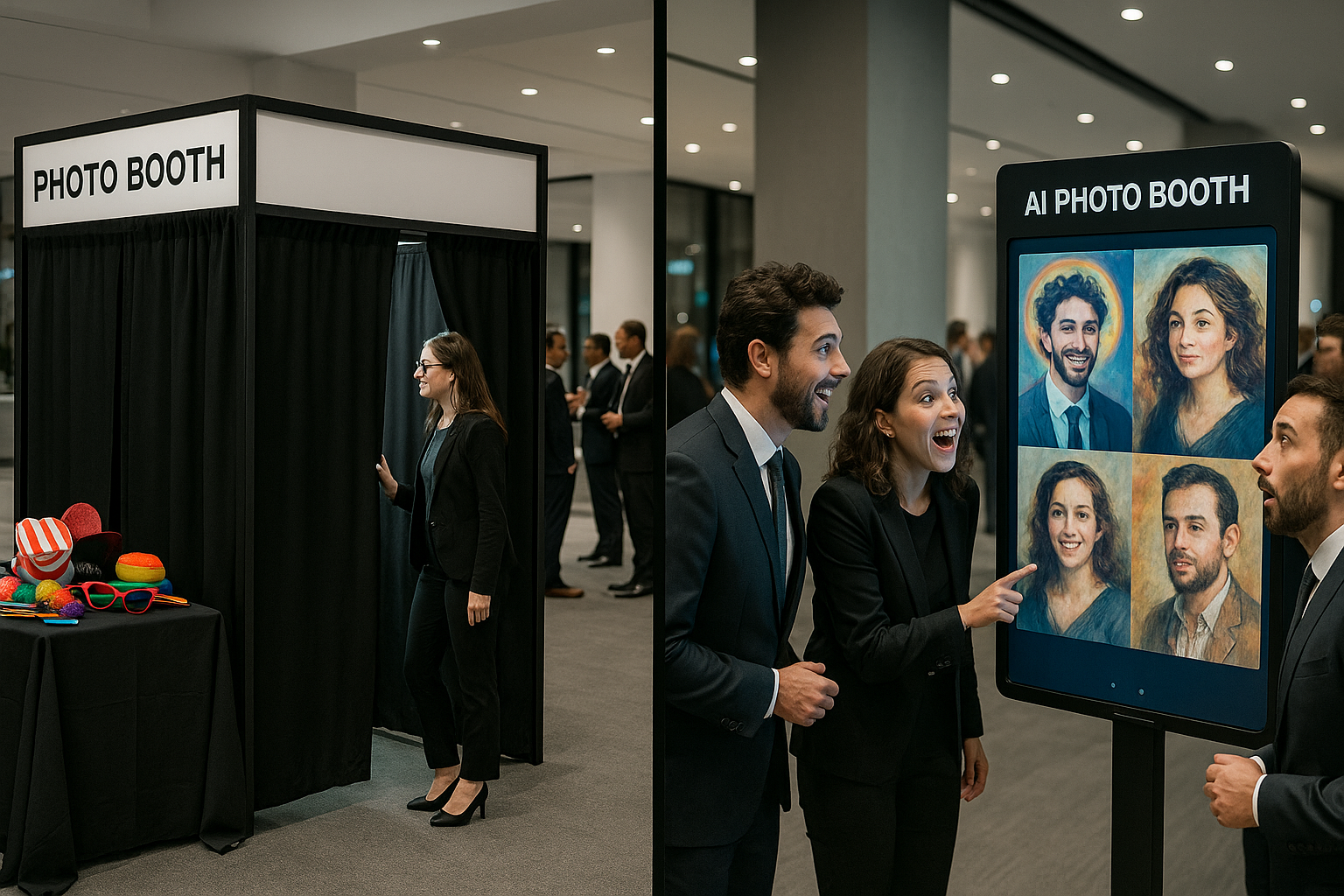
The Photo Booth Evolution: From Film Strips to AI Art
The photo booth has been an event staple since the 1920s. What began as coin-operated machines printing black-and-white film strips in train stations has evolved into one of the most powerful engagement tools in modern event marketing. But with the arrival of generative AI, the gap between traditional photo booths and AI-powered alternatives has become a canyon.
If you are planning a corporate event, brand activation, wedding, or trade show in 2026, the choice between a traditional photo booth and an AI photo booth will shape your guest experience, social media reach, and event ROI. Here are the 10 key differences every event planner needs to understand.
1. Output Quality: Filtered Snapshots vs AI-Generated Art
Traditional photo booths capture standard digital photos, then apply basic filters — think sepia tone, black-and-white, or brightness adjustments. The result is a pleasant but predictable snapshot that looks like every other photo booth photo strip.
AI photo booths fundamentally transform the image. Using generative AI models, they turn a simple selfie into a fully rendered piece of digital art — oil paintings, anime characters, cyberpunk portraits, pop art, watercolour illustrations, and hundreds of other styles. At PONS.ai, our proprietary AI engine generates these transformations in approximately 10 seconds, producing output that guests genuinely want to share.
The difference: A traditional photo booth gives you a memory. An AI photo booth gives you a collectible.
2. Personalization: One-Size-Fits-All vs Infinite Customization
Traditional booths offer a fixed set of options. You choose a backdrop, a frame design, maybe a colour filter, and every guest gets the same combination. Customization typically means swapping physical props — wigs, glasses, silly hats — which degrade over the course of a long event.
AI photo booths deliver true personalization at scale. Each guest receives a unique, AI-generated image tailored to the event theme, the brand's visual identity, and even the individual's preferences. At a PONS.ai activation for Starbucks across APAC, each guest received AI-generated portraits styled to match Starbucks' seasonal campaign — no two outputs were identical, yet every image was unmistakably on-brand.
The difference: Traditional booths customize around the booth. AI booths customize around the guest.
3. Brand Integration: Logo Overlays vs Full Creative Control
With traditional photo booths, brand integration usually means adding a logo to the photo strip border, a branded backdrop, or a custom frame. The branding exists alongside the photo but does not shape the creative itself.
AI photo booths embed the brand into the actual image generation. The AI model can be trained or prompted to incorporate brand colours, visual motifs, mascots, product imagery, and campaign themes directly into the generated artwork. When PONS.ai activated at the LONGINES International Jockeys' Championship, every AI-generated portrait incorporated the brand's equestrian elegance and signature blue, gold, and white palette — the brand was not overlaid on the photo but woven into the art itself.
The difference: Traditional branding is decorative. AI branding is generative.
4. Guest Throughput: Queues vs Volume
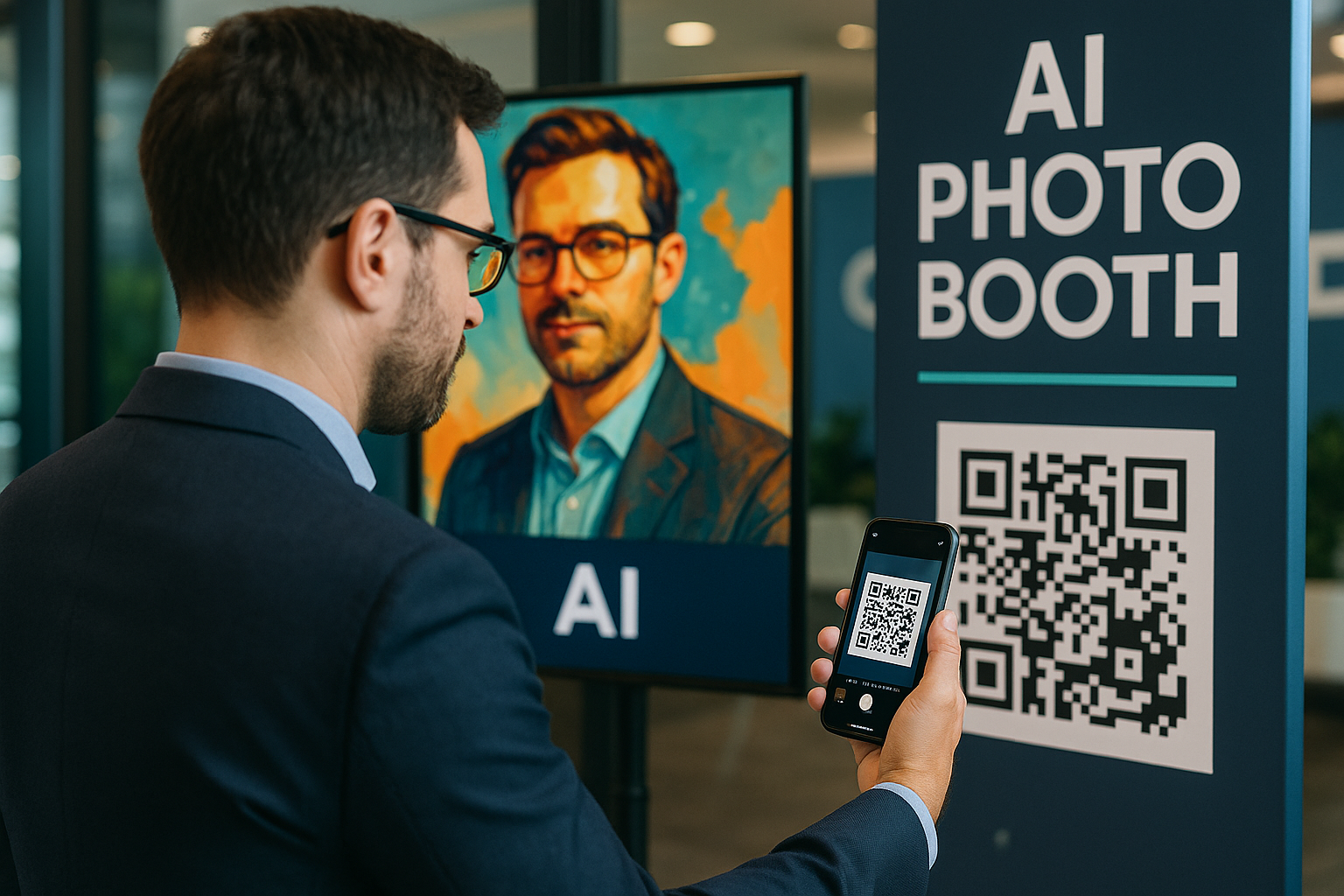
Traditional photo booths typically process 3–5 groups per 10-minute window. Guests enter, pose, wait for prints, collect their strip, and exit. With enclosed booths, only 2–4 people fit at a time. On a busy night, this creates long queues — and many guests simply walk past rather than wait.
AI photo booths dramatically increase throughput. A single PONS.ai station can process 60–100+ guests per hour because the workflow is streamlined: take a photo, select a style, receive your AI-generated image via QR code in under 15 seconds. No printing delays, no physical bottleneck. At the BLAST Premier esports tournament, PONS.ai processed over 800 unique portraits in a single day across just two stations.
The difference: Traditional booths serve dozens. AI booths serve hundreds — at the same event.
5. Content Volume: 3–4 Photos vs 10–50+ Per Guest
A traditional photo booth session yields 3–4 nearly identical photos on a single strip. Maybe you get a goofy face, a serious face, and a group squeeze. That is the extent of the content.
AI photo booths multiply content exponentially. Each guest can generate multiple AI artworks in different styles — a corporate headshot, a fantasy portrait, a pop art version, an anime transformation. At corporate activations powered by PONS.ai, guests typically generate 8–15 unique images per visit, and the most engaged users create 30+ variations. This content cascade feeds social media, internal communications, and follow-up campaigns for weeks after the event.
The difference: Traditional booths produce souvenirs. AI booths produce content libraries.
6. Sharing and Distribution: Physical Prints vs Instant Digital
Traditional photo booths produce physical prints — photo strips, 4×6 prints, or occasionally Polaroid-style outputs. Some modern traditional booths add email or SMS delivery, but the primary output remains a tangible keepsake. These prints rarely make it to social media because scanning a photo strip is an extra step most guests skip.
AI photo booths are digital-native. Every image is delivered instantly via QR code, shareable to Instagram, TikTok, WhatsApp, WeChat, and LinkedIn in seconds. PONS.ai's platform tracks that over 78% of guests share their AI-generated portraits on at least one social platform within 24 hours of the event. That organic sharing turns every guest into a brand ambassador.
The difference: Traditional outputs stay in wallets. AI outputs go viral.
7. Data and Analytics: Guesswork vs Real-Time Insights
Traditional photo booths generate almost zero data. You know how many prints were made, and that is about it. There is no guest identification, no engagement metrics, no sharing analytics, and no lead capture unless you manually add a guestbook.
AI photo booths are data engines. PONS.ai's analytics dashboard tracks total generations, unique users, average time per session, peak usage periods, most popular styles, social sharing rates, QR code scan rates, and email opt-in conversions. At the KPMG anniversary celebration, this data revealed that the AI photo booth achieved a 73% participation rate among all event attendees — actionable intelligence for planning future activations.
The difference: Traditional booths count prints. AI booths measure engagement.
8. Setup and Logistics: Heavy Hardware vs Lean Deployment
A traditional enclosed photo booth is a substantial piece of hardware. It typically requires a dedicated 8×8 foot space, power supply, printer maintenance, prop management, backdrop installation, and often a dedicated attendant. Transport, setup, and teardown can take 2–3 hours each way.
AI photo booths run lean. A PONS.ai activation requires a tablet or touchscreen, a camera, stable internet, and a compact branded enclosure. Total footprint: as small as 4×4 feet. Setup time: under 30 minutes. The system runs unmanned, auto-recovers from errors, and needs zero consumables (no ink, no paper, no props to replace). For the Sandbox VR activation, PONS.ai deployed a fully operational AI photo booth station within 20 minutes of arriving on-site.
The difference: Traditional booths need a crew. AI booths need a power outlet.
9. Cost Structure: Per-Event Rental vs Scalable Investment
Traditional photo booth rentals typically cost USD $400–$1,500 per event for 2–6 hours. Add-ons like custom backdrops, extra prints, attendant fees, and travel charges push costs higher. Every event is a new rental expense, and the cost scales linearly — two events means double the cost.
AI photo booth pricing follows a different model. While initial setup costs may be higher, the per-event marginal cost drops significantly at scale. PONS.ai offers both per-event activations and enterprise licensing for brands that run frequent campaigns. For a brand running 10+ activations per year, the cost per engagement with an AI photo booth can be 60–70% lower than equivalent traditional booth rentals, while generating 5–10x more content and measurably higher guest engagement.
**Cost Factor** | **Traditional Photo Booth** | **AI Photo Booth (PONS.ai)**
Typical per-event cost | $400–$1,500 | Custom quote (volume discounts)
Attendant required | Yes (1–2 staff) | No (unmanned operation)
Consumables per event | $50–$150 (ink, paper, props) | $0
Content per guest | 3–4 photos | 10–50+ AI artworks
Social shares per event | Low (~5–10%) | High (~78% share rate)
Data/analytics included | No | Yes (full dashboard)
Setup time | 2–3 hours | Under 30 minutes
10. Future-Proofing: Static Technology vs Continuous Innovation
Traditional photo booths have reached a technological plateau. The core technology — camera, printer, backdrop — has not fundamentally changed in 15 years. Upgrades mean buying new hardware: a better camera, a faster printer, a fancier enclosure. Each upgrade is a capital expenditure that depreciates immediately.
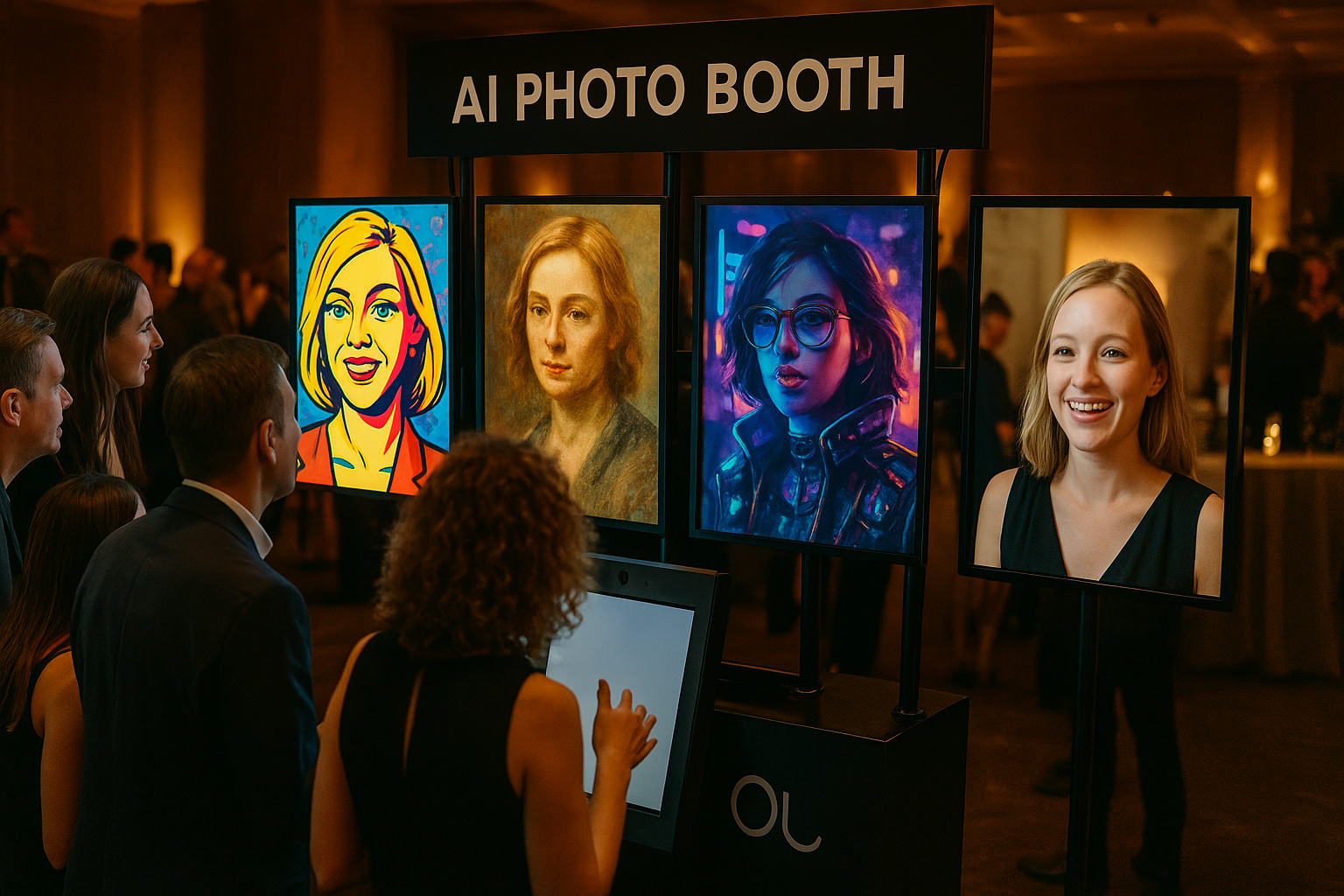
AI photo booths improve through software updates. PONS.ai's platform receives regular model upgrades that improve image quality, add new artistic styles, and expand capabilities — all without changing hardware. In 2025, PONS.ai added real-time video transformation, multi-person group portraits, and brand-specific fine-tuned models. These updates were deployed to all active installations simultaneously, at zero additional cost to clients.
The difference: Traditional booths depreciate. AI booths appreciate.
Side-by-Side Comparison: 10 Differences at a Glance
**Feature** | **Traditional Photo Booth** | **AI Photo Booth**
Output type | Standard filtered photo | AI-generated artwork
Personalization | Fixed backdrops and props | Infinite AI styles per guest
Brand integration | Logo overlay on border | Brand woven into the art itself
Throughput | 20–30 guests/hour | 60–100+ guests/hour
Content per guest | 3–4 identical photos | 10–50+ unique artworks
Sharing method | Physical print | Instant digital via QR code
Data and analytics | Print count only | Full engagement dashboard
Setup time | 2–3 hours | Under 30 minutes
Staffing | 1–2 attendants required | Unmanned operation
Technology lifecycle | Hardware-dependent upgrades | Continuous software updates
Which One Should You Choose?
The honest answer: it depends on your event goals.
Choose a traditional photo booth if:
You want a nostalgic, retro experience as the primary appeal
Physical photo strip souvenirs are essential (e.g., vintage-themed weddings)
Your budget is under $500 for a single small event
You do not need digital content or social media amplification
Choose an AI photo booth if:
Guest engagement and participation rates are priority metrics
You need branded content that guests will share organically on social media
Data and analytics matter for post-event reporting and ROI measurement
You are running multiple activations and need scalable technology
You want a "wow factor" that differentiates your event from every other gathering
For enterprise brands, agencies, and event planners who need measurable results, the shift toward AI-powered photo experiences is not a trend — it is a structural change in how events generate value. The traditional photo booth served its era well. The AI photo booth is built for what comes next.
Frequently Asked Questions
Can an AI photo booth also print physical photos?
Yes. Most AI photo booth platforms, including PONS.ai, offer optional print modules that produce high-quality prints of the AI-generated artwork. You get the best of both worlds — digital shareability plus a tangible takeaway.
Is an AI photo booth harder to operate than a traditional one?
The opposite. Traditional booths require attendants to manage props, refill printers, and troubleshoot jams. PONS.ai's AI photo booth runs autonomously with a self-service touchscreen interface. Event staff can focus on other priorities.
How long does each AI photo booth session take?
A typical PONS.ai session — from photo capture to receiving the AI-generated image — takes approximately 10–15 seconds. Traditional booths average 2–3 minutes per session including printing time.
Do AI photo booths work without internet?
PONS.ai offers both cloud-based and edge-processing configurations. For venues with limited connectivity, on-premise processing ensures the experience runs smoothly without relying on internet speed.
What about data privacy with AI photo booths?
PONS.ai is built with enterprise-grade security. Guest photos are processed and delivered but never stored long-term without explicit consent. The platform complies with GDPR, PDPO (Hong Kong), and other regional data protection regulations. All data is encrypted in transit and at rest.
Book a demo with PONS.ai to see the difference firsthand and discover which solution fits your next event.


Comments