
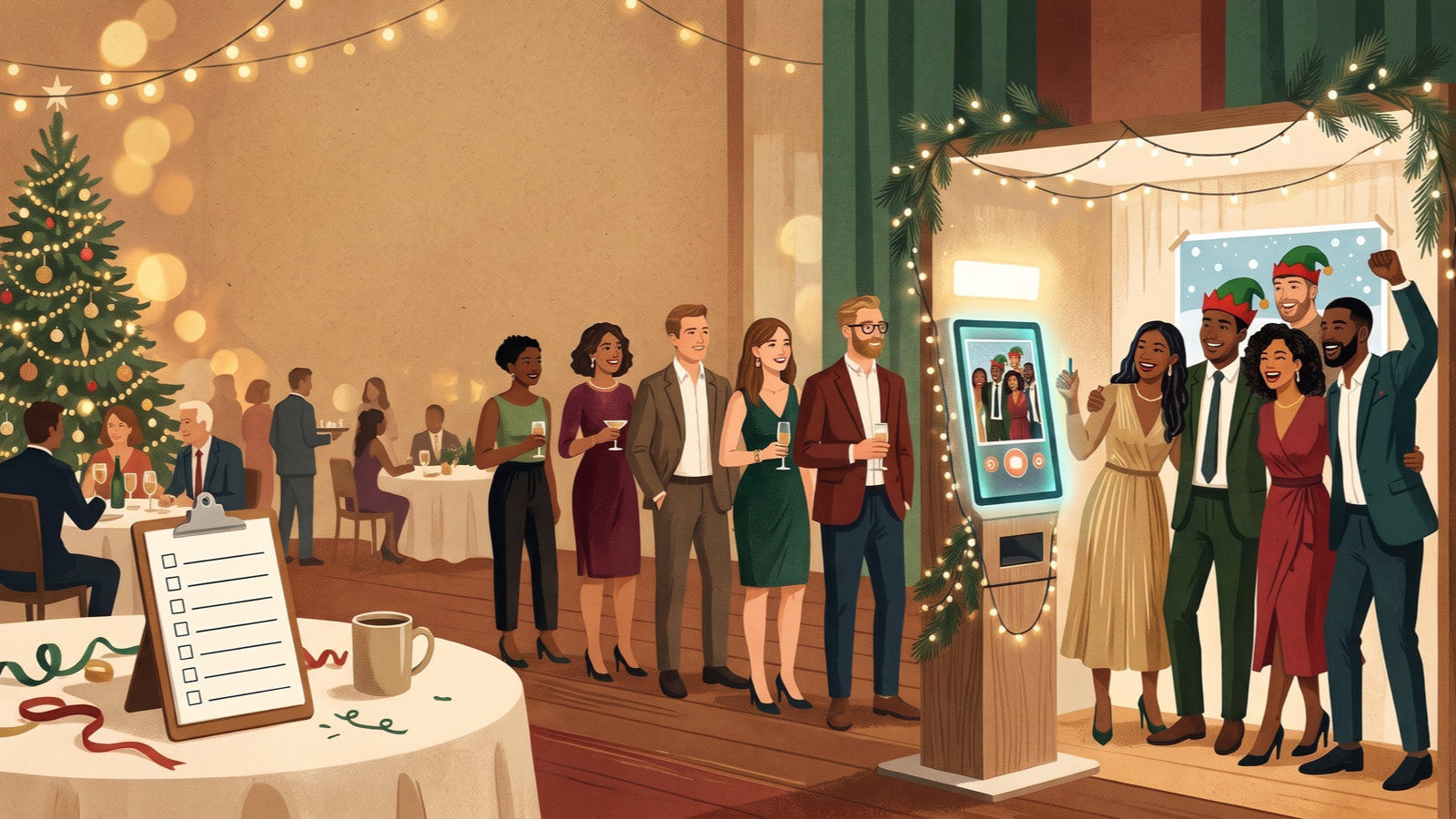
Christmas Party AI Photo Booth: Planning


A Christmas party AI photo booth should be booked against an agreed guest journey, not just a festive image style. Confirm your event date, venue access, output format and approval owner before accepting a quote; availability and production time need an event-specific answer. For company year-end celebrations and public-facing brand activations, the useful question is whether the whole experience works during your programme. This guide provides a production brief, acceptance checklist and operating plan—not a promise that one booth can serve every guest in a fixed time.
Start with the PONS.ai AI photo booth formats and demonstrations. For a Hong Kong celebration, discuss your actual venue and date through the Hong Kong AI photo booth service enquiry page. For Singapore corporate parties, product launches or interactive brand activations, use the Singapore AI photo booth service enquiry page. These are enquiry destinations, not confirmation of local staffing or an available date.
Christmas party AI photo booth planning: define the decision first
An employee dinner, a shopping-centre activation and a customer appreciation evening have different success criteria. A staff party might prioritise a keepsake and a relaxed shared activity. A public activation needs clearer queues, signage, consent and support for people unfamiliar with the brand. A customer event may require more conservative imagery and tighter restrictions on public galleries. Decide which situation you are buying for before discussing visual treatments.
Write one sentence describing the desired experience: “Colleagues can create an optional festive portrait during arrivals and receive a branded digital keepsake.” That is more operationally useful than “make it viral.” It identifies the audience, the programme window, the output and the fact that participation is optional. A supplier can test that sentence against a proposed setup and identify gaps before the event.
PONS.ai publishes this guide as a supplier, not an independent ranking organisation. Founder Kelvin Tang is the named author. Recommendations below are planning advice; suggested schedules and tests are not published service guarantees. Request a demonstration using your own event brief before deciding whether the format fits your party.
Choose an output before you choose a theme
The guest-facing deliverable changes the production plan. A digital portrait needs an agreed retrieval method. A printed keepsake adds printer placement, consumables, collection and waste handling. A gallery adds decisions about who can see which images and when access ends. A campaign asset adds brand review and rights questions that a private party portrait may not need.
A transformation preview is not necessarily the final print file. Ask to inspect the exact framing, resolution, crop and logo treatment intended for each output. A design that looks attractive on a phone can lose fine text or faces when placed in a small print frame. Approve the actual deliverables, not only a supplier's promotional demonstration.
Output choice | What the buyer should approve | Operational consequence |
|---|---|---|
Individual digital portrait | Likeness, composition, retrieval screen and branding | Guests need a clear way to receive their own result |
Printed portrait | Physical proof, crop, paper finish and collection method | Printing and collection need their own space and timing |
Team or group image | Tested group size and treatment of every face | Capture instructions and retries may differ from individual portraits |
Private event gallery | Access rules, visibility and expiry | Sharing and retention need explicit agreement |
Public activation content | Brand review and separate promotional permissions | Participation must not silently become a marketing opt-in |
Treat each row as a scope decision. A proposal that includes digital delivery does not automatically include printing, a public gallery or advertising rights. Put exclusions beside inclusions so procurement can compare equivalent offers.
Build an approval calendar by dependencies
There is no universal booking deadline that proves a supplier will be free. Instead, work backwards from dependencies: venue confirmation, supplier availability, creative review, privacy review, equipment and staffing confirmation, then the final rehearsal. If any dependency is unresolved, identify its owner and the decision needed. A shorter production window usually calls for a simpler approved concept rather than an unsupported promise of faster delivery.
At the initial enquiry, provide the date, city, venue, anticipated attendance and programme. Ask the supplier to state when it needs approved assets and when changes stop being included in the agreed scope. When multiple teams need to sign off, appoint one person to return consolidated feedback. Conflicting comments from marketing, HR and procurement can otherwise produce repeated revisions without a clear acceptance decision.
The following sequence is a suggested planning framework, not a PONS.ai lead-time commitment:
Scope gate: confirm the buyer, event objective, date, venue and proposed format.
Feasibility gate: agree access, power, connectivity, staffing and contingency responsibilities.
Creative gate: approve the style, supplied artwork, sample outputs and permitted variations.
Operational gate: agree guest instructions, retrieval, print collection and incident escalation.
Go-live gate: rehearse the full experience in the final configuration before guests arrive.
For short answers about the initial booking conversation, see the existing holiday party AI photo booth FAQ. This article goes further into approvals and acceptance. Do not treat a generic lead-time range as evidence of actual availability, or a generation-time claim as a complete guest-flow plan.
Brief a festive style without sacrificing identity
Choose a style that suits the audience and the role of the image. A formal employee gala may suit an illustrated winter portrait or an elegant seasonal setting. A playful department celebration can use a more expressive visual direction. A luxury customer evening may call for quieter branding and restrained effects. These are creative options to test, not a list of pre-approved packages.
Provide original brand assets and identify where they may be used. Keep the logo separate from the generated portrait when exact artwork matters, and approve its final placement. Decide whether names, dates or campaign messages belong in the frame; verify spelling in the exported output. A recognisable brand mark should not be replaced by a loosely generated imitation.
Test the proposed style with a varied, consented sample rather than one ideal promotional image. Review skin tones, hair, glasses, head coverings, formalwear and any accessibility requirements relevant to the audience. Ask what happens if the guest dislikes the result or if an accessory is changed unexpectedly. A clear option to retry or decline is more useful than describing every result as flawless.
Put the booth into the programme, not beside it
Map when people can actually participate. Arrivals may be busy, dinner may restrict movement, and an awards presentation should not compete with a noisy queue. Mark the booth's open periods on the run sheet and identify when staff should pause new captures. A supplier needs this information to plan operation; total event duration alone is not enough.
Ask for a venue layout showing capture, waiting, operator access and output collection. Keep exits, service corridors and accessible routes clear. If printing is included, position collection so guests do not return against the queue. Avoid putting a bright screen where it distracts from the stage or photographs poorly under changing entertainment lighting.
Confirm the actual access route, not simply the room name. Loading areas, lifts, security checks and permitted setup times may affect what can be brought in and when. Ask the venue to approve the equipment footprint and power arrangements. Any dimensions in a supplier brochure are a starting point; the event configuration still needs written confirmation.
Model guest flow using a full-cycle test
AI generation can be one part of a much longer journey. A guest may need an explanation, a consent decision, a style selection, a capture, a review and help retrieving the image. Printing and retries can add further stages. A headline such as “about ten seconds” must never be multiplied into an hourly attendance promise without measuring the rest of that process.
Run a timed rehearsal with people who have not seen the interface. Record the complete experience, including questions and unsuccessful attempts. Separate capture time from generation and delivery time if those stages run independently. Ask whether the next guest can begin while an earlier image is processing, and whether any shared screen exposes the previous guest's image.
Then compare the observed workflow with the actual participation window. If demand is likely to exceed the demonstrated capacity, discuss a longer operating period, simpler choices, another station or a different participation model. These are options to evaluate with the supplier, not assumptions about included equipment or automatic parallel processing. Document the agreed plan and the trigger for changing it on the night.
Test venue connectivity and the recovery path
Ask what connectivity each component needs and who supplies it. Capture, generation, retrieval and printing may depend on different connections. A hotel guest network that works for browsing is not proof that the final setup will work. Arrange a test of the proposed configuration and confirm who is responsible for venue permissions or network restrictions.
The contingency should be specific enough for the operator to explain. If connectivity drops, does capture pause, can already completed images still be retrieved, and how are guests informed? If a printer stops, can the digital experience continue under the agreed scope? Do not describe an experience as offline-capable unless that exact configuration has been demonstrated and confirmed.
Agree an escalation contact for the venue, organiser and supplier. Give the event lead authority to pause the activity when necessary rather than keeping a confusing queue open. The recovery standard should focus on a clear guest outcome: explain the pause, protect images already created and resume only when the agreed workflow is functioning.
Compare quotes on the same scope
Ask each supplier to price the same operating window, outputs and responsibilities. A low headline quote may exclude venue access charges, additional hours, print consumables, operator support or custom creative work. Equally, a larger package may include elements your party does not need. The comparison should reveal these differences rather than compress them into a single price per guest.
PONS.ai pricing for your particular party requires a confirmed scope and quotation. An event-specific price is not published in this guide. Competitor event pricing is also not published here because no like-for-like, dated quote has been verified for your requirements. Do not substitute another client's package or a software subscription for the cost of an operated event.
Use the following headings in the commercial comparison: equipment, transport, access and setup, operating hours, staffing, creative development, included revisions, digital delivery, print quantities, support, taxes and exclusions. Include cancellation, date changes and overtime terms. For procurement structure, consult the existing AI photo booth RFP and supplier scoring template.
Keep festive participation separate from promotional permission
Explain what the guest is submitting, what will be generated and how the result will be delivered. Identify who handles the images, which service providers are involved, where relevant processing occurs and how deletion requests are handled. Ask for the actual retention and access arrangements rather than a broad statement that the experience is “secure.”
A person requesting their own portrait has not necessarily agreed to receive future marketing or to appear in a public campaign. Keep optional promotional choices clear and separate from the core participation flow. For employee parties, make it comfortable to decline without explanation. If children or external guests may participate, have the organiser's responsible team review the proposed process before launch.
Do not claim universal legal compliance from a logo or a client list. Requirements depend on the event, data flow and jurisdiction. Ask your privacy or legal reviewer to approve the actual notices and permissions. The booth should implement the agreed process, and the operator should know where to direct questions they cannot answer.
Use enterprise examples for proof, not borrowed promises
Existing case studies can show the kinds of brand environments a supplier has worked in. They do not establish that your venue, event date or creative concept has already been tested. Ask which elements of a published activation are relevant to your plan: visual direction, audience instructions, physical setup or the structure of the guest journey.
The published KPMG anniversary AI photo booth case study provides one concrete example of PONS.ai enterprise-event work. Use the demonstrations and case studies linked from the main booth hub to discuss a comparable use case, then ask for evidence of the specific capability you need. Avoid copying throughput, image counts or outcome claims into your own brief unless the underlying evidence and conditions are available.
There are also different purchasing models in this category. Snapbar's official AI photo booth page describes a browser-based AI portrait experience. That establishes a real alternative to investigate, not a verified equivalent to an operated PONS.ai activation. Confirm each supplier's hardware, staffing, delivery and regional scope directly before comparing prices or capabilities.
Adapt the brief to the market and audience
A Christmas theme is not automatically suitable for every year-end event. Ask the organiser how the celebration is described, which imagery is welcome and which languages guests need. A Singapore regional gathering may need different instructions from a Hong Kong employee dinner. Language, tone and cultural styling should be approved as part of the creative brief rather than assumed from the city name.
For distributed teams, separate a shared visual concept from local delivery. Each venue still needs its own availability, access, equipment and support confirmation. A supplier's international portfolio does not prove a local office or an available crew in every city. Keep the service enquiry specific to the place and date, and do not present a translated page as proof of staffed delivery.
This English guide supports Christmas-party planning; it is not a replacement for the existing local-language market guides. If your event needs translated instructions or image text, request samples in the required language and inspect the final output. Translating a paragraph is not the same as testing the whole guest journey, including retrieval, notices and support.
Send a supplier brief that can be quoted
Copy the following fields into your enquiry and fill in what you know. Mark unresolved items as pending rather than inventing precise requirements. A supplier can then identify the information needed for a defensible proposal.
Event: company celebration or public activation, city, venue, date and contact owner.
Audience: expected attendance, likely participants, accessibility considerations and languages.
Programme: arrival, dinner, speeches and preferred booth operating windows.
Output: digital portrait, print, gallery or a combination, with collection requirements.
Creative: theme, original artwork, text, approval owner and sample-review expectations.
Operations: access route, setup permission, power, network and proposed staffing responsibilities.
Data: participation notice, delivery method, retention questions and promotional permissions.
Commercial: required quotation scope, exclusions, change terms and approval process.
Attach a floor plan if available and tell the supplier which decisions are still subject to venue approval. Ask for an explicit list of assumptions in the quotation. This keeps an early estimate from becoming an accidental commitment to an untested configuration.
What should the final acceptance check cover?
Before opening, run the complete flow with the final assets and output settings. Check the image, branding, notices, retrieval and any physical print. Confirm who can pause the booth and who communicates with waiting guests. Record the acceptance decision and any remaining limitations so the event team is not relying on an informal “looks fine.”
After the event, review what was actually delivered: participation where measured, completed outputs, support incidents and guest feedback. Sharing is not the same as a qualified enquiry, and an enquiry is not a booking. For an employee celebration, a clear, enjoyable keepsake experience may be the appropriate objective without inventing a sales return.
When should we enquire about a Christmas party AI photo booth?
Enquire once you have a likely date, city and event format, then confirm supplier availability and the dependencies for your scope. There is no reliable universal deadline or promise of a last-minute slot. If the event is close, simplify the proposed creative and ask what can genuinely be demonstrated and approved in the remaining window.
Should we choose prints or digital portraits?
Choose the output that supports your guest journey and budget, then test it. Prints offer a physical keepsake but require collection, consumables and a demonstrated production workflow. Digital portraits remove those print-specific steps but still need a clear retrieval method. Neither choice eliminates consent, branding approval or support requirements.
Can we use the booth as a Singapore brand activation?
A Singapore brand activation can use an AI portrait experience if the creative, guest flow and permissions support the campaign. Discuss the venue, dates, required outputs and intended promotional use through the Singapore service page linked above. Confirm delivery and staffing for that event rather than assuming a corporate-party package covers a public activation.
What is the next step with PONS.ai?
Send your date, city, venue, attendance and preferred outputs, then request a demonstration against that brief. Review the sample deliverables and the complete operating plan before approving the quotation. The objective is a festive experience your guests can understand and enjoy, with responsibilities clear before the doors open.
Book a demo with PONS.ai


Comments