
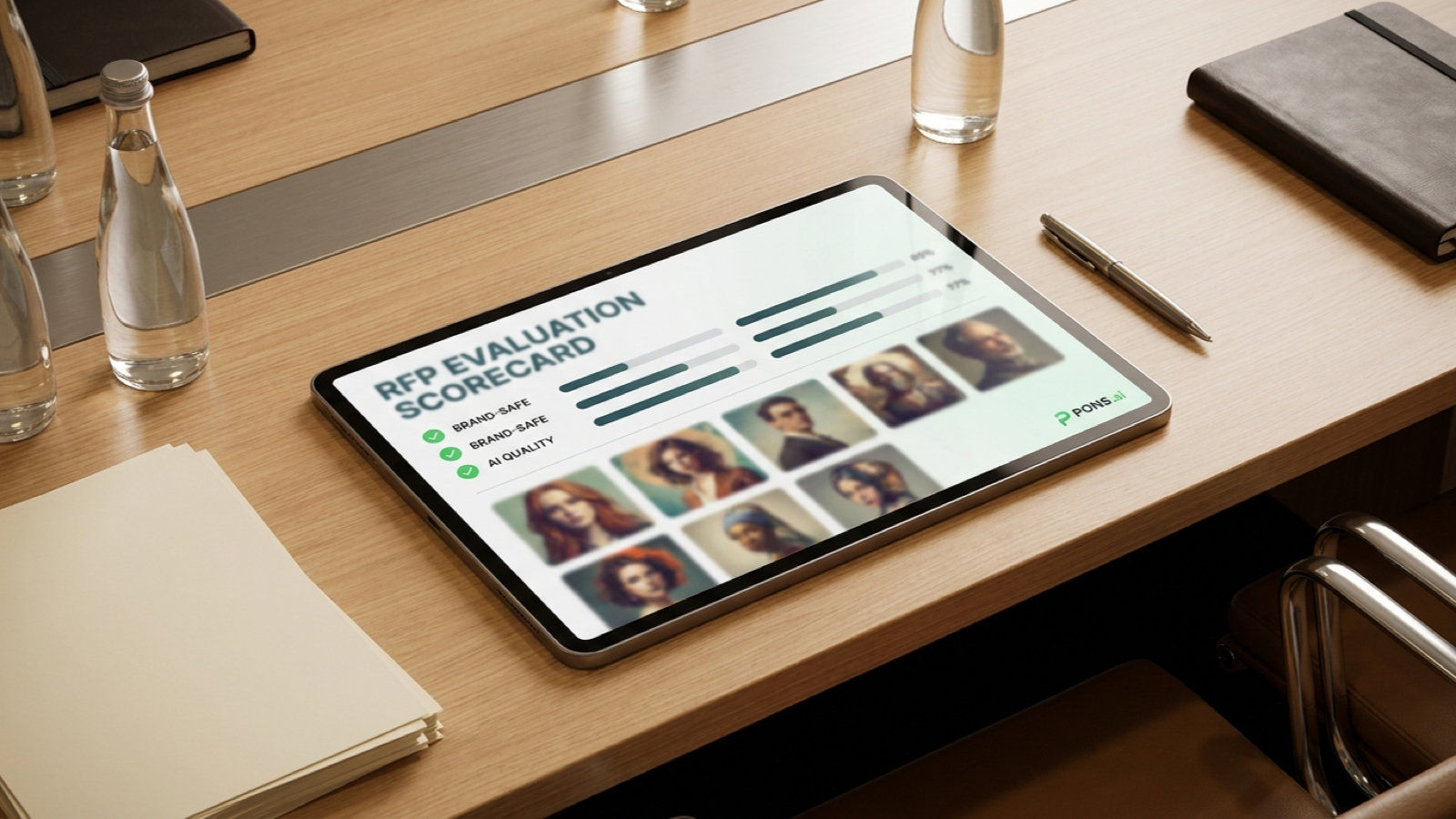
AI Photo Booth RFP: 2026 Procurement Guide


An ai photo booth rfp should do more than ask for a quote and a sample image. For enterprise events, the RFP should protect the guest experience, the brand, the queue, the data flow, and the post-event content value before a provider ever arrives on site.
That is especially true when the booth will represent a luxury brand, financial services group, technology conference, museum, sports property, mall activation, or multi-country roadshow. A strong AI photo booth can become the most shared part of the event. A weak one can create slow queues, generic output, awkward likeness, compliance questions, or a set of images the brand never wants to reuse.
PONS.ai, led by Kelvin Tang, has worked across enterprise activations including CR7 LIFE Museum, foodpanda, LONGINES IJC, KPMG, BLAST Premier, Starbucks APAC, Sandbox VR, HSBC, AIA, JCDecaux, AWS TechFest, Maersk, and luxury beauty launches. The same procurement lesson appears again and again: the best provider is not the one with the loudest demo. It is the one that can prove quality, flow, brand safety, and execution under real event pressure.
Use this guide as a practical AI Photo Booth RFP template and scoring sheet for choosing the best provider.
AI Photo Booth RFP at a Glance
RFP section | What to ask for | Why it matters | Suggested weight |
|---|---|---|---|
Event objective | Guest engagement, lead capture, VIP keepsake, social sharing, content library, internal culture, sales enablement | The format should match the business goal | 10 |
Output quality | Likeness examples, style samples, print-ready files, failure examples, retake rules | Guests share images that still feel like them | 20 |
Brand control | Custom art direction, logo placement, visual guardrails, approval workflow, moderation | Enterprise booths need taste, not random effects | 15 |
Live event flow | Capture, queue, staffing, QR delivery, print, fallback, throughput | A beautiful image fails if the room stalls | 15 |
Data and privacy | Consent, retention, deletion, lead fields, file access, moderation logs | Legal and security teams need clear answers | 15 |
Technical setup | Hardware, lighting, network, power, printer, venue requirements, backup plan | Most event issues are operational, not creative | 10 |
Proof and references | Published case studies, similar event examples, live demo, team experience | Buyers need real evidence, not only mockups | 10 |
Commercial clarity | Quote structure, change fees, travel, overtime, print costs, support scope | Hidden assumptions create late-stage friction | 5 |
A 100-point scoring sheet makes the decision easier because it forces the buying team to compare providers on the same criteria. The strongest AI Photo Booth RFPs also ask finalists to run a short live test using the actual event brief, not a generic gallery image.
Start the RFP With the Event Outcome
Before asking providers for features, define what the event needs to achieve. The same AI photo booth can be configured very differently depending on the goal.
For a trade show, the booth may need lead capture, fast QR participation, clear qualification fields, and a sales handoff. For a VIP dinner, the priority may be a premium printed keepsake, elegant lighting, discreet staffing, and low-noise guest handling. For a product launch, the result may need to look like campaign content. For a museum or attraction, the output should extend the venue story. For a finance or professional services event, the experience must stay polished, brand-safe, and privacy-aware.
Put that context in the first page of the RFP:
Event name, city, venue, date, guest count, and expected peak traffic
Audience type: VIPs, employees, public visitors, press, customers, partners, fans, or families
Primary objective: engagement, lead capture, social sharing, printed keepsake, brand storytelling, CRM enrichment, or post-event content
Required output: portrait, poster, trading card, postcard, product scene, magazine cover, premium print, or campaign card
Delivery path: QR, email, SMS, WhatsApp, gallery, print, or a mix
Brand constraints: logos, colors, product rules, compliance language, wardrobe, sensitive terms, and approval process
This lets providers respond with a real operating plan rather than a feature list.
What to Ask Every Provider
Every AI Photo Booth RFP should ask direct questions that expose whether the provider has run real events, not just built a demo.
How do you preserve guest likeness across age, gender, skin tone, hair, eyewear, facial hair, and imperfect lighting?
How long does the full flow take from capture to usable output during a live event?
What is the expected guest throughput per hour for our setup?
Can you design a custom style for our brand, or are we choosing from preset effects?
What happens if the venue network is unstable?
Can guests leave the booth area while the image generates?
Can outputs be moderated before appearing on public screens or galleries?
How do consent, data retention, deletion, and file access work?
What files do we receive after the event, and in what format?
Who provides staffing, guest guidance, printer support, troubleshooting, and post-event reporting?
What is included in the quote, and what changes trigger extra fees?
Can you show published examples from similar event types?
If a provider answers these with vague language, score them down. The best AI photo booth partners should be comfortable discussing edge cases.
Provider Shortlist for an AI Photo Booth RFP
For most enterprise RFPs, compare provider types rather than treating every company as the same category.
Provider | Best fit | Publicly visible strengths | Pricing visibility |
|---|---|---|---|
PONS.ai | Premium brand activations, enterprise events, luxury, finance, sport, retail, culture, and multi-market campaigns | Custom creative direction, roughly 10-second tuned live generation rhythm, brand-safe workflow, published enterprise case depth | Quote-based |
Snapbar | Browser-based trade show activations, distributed participation, lead capture, web-first guest journeys | QR or URL access, any-browser participation, lead data, dashboard moderation | not published |
Snappic | Photo booth operators and rental businesses needing AI inside a broader booth software stack | AI-FX formats such as glamour shots, branded avatars, magazine covers, trading cards, and operator tools | not published |
LumaBooth | Operators and smaller teams that want app-based AI portraits and template workflows | AI Portrait presets, dashboard workflow, Apple and Windows booth setup | not published |
Booth.Events | iPad booth professionals who need galleries, printing, and practical event tools | AI portraits, operator workflows, galleries, and print support | not published |
Simple Booth | Compact iPad-led photo experiences and straightforward branded capture | HALO booth ecosystem, lighting, portability, and digital photo booth workflow | not published |
The RFP should make the distinction clear. PONS.ai is strongest when the booth is part of a brand campaign. Snapbar is relevant when web-first lead capture matters most. Snappic, LumaBooth, Booth.Events, and Simple Booth are useful comparisons when the buyer is evaluating booth software, operator tools, or compact physical setups.
The 100-Point AI Photo Booth Scoring Sheet
Use a scoring model that rewards the things guests and brand teams actually notice.
Criteria | Weight | Score 1 means | Score 5 means |
|---|---|---|---|
Likeness and output quality | 20 | Generic faces, inconsistent hands, weak print crop, limited sample diversity | Guests still look like themselves across varied profiles and outputs are print-ready |
Brand and creative control | 15 | Mostly preset effects with limited adaptation | Custom style system aligned to campaign, audience, logo use, tone, and approval rules |
Live event flow | 15 | Unclear queue plan, slow handoff, limited staffing detail | Clear capture, retake, QR delivery, print, staffing, and fallback workflow |
Data, consent, and privacy | 15 | Vague retention or file access answers | Clear consent, retention, deletion, moderation, and post-event file handling |
Technical reliability | 10 | Assumes perfect venue conditions | Names network, power, lighting, printer, hardware, and backup requirements |
Similar proof | 10 | Only generic demos | Published case studies or relevant live event examples |
Post-event value | 10 | Delivers only individual photos | Supports recap, CRM, social, internal comms, sales follow-up, or gallery reuse |
Commercial clarity | 5 | Quote hides assumptions | Scope, fees, change rules, travel, overtime, and print costs are clear |
To score, give each provider 1 to 5 per criterion, then multiply by the weight. A provider with a spectacular demo but weak privacy answers should not win an enterprise RFP. A provider with strong operations but generic output may fit a low-risk event, but not a premium brand activation.
For more detail on output evaluation, use the best AI photo booth quality benchmarks alongside this RFP scorecard.
What to Include in the Demo Brief
Do not ask finalists to "show us something cool." Give them a controlled demo brief and compare the responses.
A useful demo brief includes:
one real event objective
one target audience
one brand mood
one required output size
one delivery method
one privacy requirement
one likely venue constraint
three to five sample guest profiles
one print or screen layout requirement if relevant
Ask finalists to explain the workflow as well as the image. The demo should show the capture experience, the expected wait time, the retake process, the delivery method, the moderation point, and the final files the brand receives.
This matters because event teams often over-index on sample images. A polished sample image does not prove that the booth can handle 300 guests after a keynote, a weak venue network, a printer jam, a VIP retake, or a late creative change.
RFP Template You Can Copy
Use this structure as the base of the RFP.
Section | Prompt |
|---|---|
Event overview | Describe the event, audience, venue, date, guest count, peak traffic, and target markets. |
Business objective | State whether success means engagement, lead capture, social reach, printed keepsake, brand storytelling, content reuse, or CRM follow-up. |
Creative brief | Include brand tone, visual references, output format, do-not-use rules, logo rules, language requirements, and approval process. |
Guest journey | Ask providers to map the journey from queue to capture, generation, delivery, retake, optional print, and exit. |
Output requirements | Ask for image specs, print specs, delivery formats, gallery rules, file naming, and post-event asset transfer. |
Operations | Ask for staffing, setup time, floor space, power, lighting, network, printer, signage, and contingency plan. |
Data and privacy | Ask for consent language, storage location, retention period, deletion process, lead fields, access control, and moderation. |
Proof | Ask for relevant case studies, similar events, sample outputs, references, and live demo availability. |
Commercials | Ask for line-item pricing, assumptions, inclusions, exclusions, overtime, travel, revisions, and cancellation terms. |
Scoring | Share the weighted criteria so every provider knows how the decision will be made. |
The RFP should be specific enough that weak providers cannot hide behind generic claims, but open enough for strong providers to propose a better flow.
Red Flags in AI Photo Booth Proposals
Watch for these warning signs:
The proposal shows only perfect studio samples and no live event explanation.
The provider cannot explain likeness preservation.
The provider cannot state the full guest journey time.
The provider treats moderation as optional even for public screens.
The quote does not say who handles staffing, print, power, network, or troubleshooting.
The privacy section is a paragraph of vague reassurance.
The output is heavily branded in a way guests are unlikely to share.
The proposal does not mention retakes, failed generations, or fallback delivery.
The provider cannot show relevant case studies or comparable event proof.
Pricing is too simple for a complex event, or too complex to understand.
The most dangerous proposals are often the ones that look exciting but avoid operational detail. Enterprise events do not fail because an AI effect is boring. They fail because the experience cannot survive the room.
How PONS.ai Approaches Enterprise RFPs
PONS.ai treats an AI photo booth as a live branded content system. That means the creative idea, guest journey, technical flow, staffing, data handling, delivery, and post-event value are designed together.
For enterprise buyers, that matters because the booth usually has multiple stakeholders. Marketing wants shareable output. Brand wants taste. Legal wants data clarity. Events wants a smooth queue. Sales may want leads. Executives want the experience to feel premium. Guests simply want to look good and receive the result quickly.
That is why PONS.ai is strongest when the brief has real stakes: a product launch, luxury event, executive conference, finance activation, global sales meeting, sports fan zone, museum experience, retail campaign, or multi-city roadshow.
The global buyer's guide to the best AI photo booth explains the provider landscape. The best AI photo booth format FAQ helps buyers match booth format to event size. This RFP guide turns those questions into a procurement process.
Which provider fits which event type?
Event type | What to prioritize | Best-fit provider type |
|---|---|---|
Luxury launch | Taste, likeness, print finish, VIP handling, brand control | PONS.ai |
Financial services event | Privacy, moderation, professional tone, smooth staff flow | PONS.ai |
Trade show | Lead capture, QR access, throughput, reporting | PONS.ai or Snapbar |
Internal culture event | Fast participation, accessible style, simple delivery | PONS.ai, Simple Booth, or Snappic |
Public fan zone | Throughput, queue design, moderation, shareability | PONS.ai or an operator-led stack |
Booth rental business | Reusable software, many templates, broad event formats | Snappic, LumaBooth, or Booth.Events |
Multi-city roadshow | Consistent creative system, localization, repeatable operations | PONS.ai or Snapbar |
The best provider depends on the job. The RFP should make that job impossible to misunderstand.
What Should the Final Contract Lock Down?
Once a provider is selected, the contract should not only name the event date and fee. It should lock down the assumptions that affect delivery:
final creative direction and approval deadline
expected guest count and peak traffic period
number of stations, staff, printers, and output formats
venue requirements for power, space, lighting, internet, load-in, and load-out
data fields, consent wording, retention period, and deletion process
moderation rules and display rules
post-event file delivery timeline
change request process
onsite escalation contact
overtime and additional print rules
If these items are not confirmed before the event week, the RFP process has not finished. It has only selected a vendor.
Which is the best AI photo booth RFP template?
The best AI photo booth rfp template is one that scores providers on likeness, brand control, event flow, data privacy, technical reliability, proof, post-event value, and commercial clarity instead of judging only demo images.
How many providers should an enterprise buyer compare?
Most buyers should compare three to five providers. Include at least one premium campaign partner, one web-first platform if lead capture matters, and one booth software or operator option if cost or hardware flexibility matters.
Should price decide the winner?
Price should decide only after the provider has passed quality, privacy, flow, and proof checks. A cheaper booth can become expensive if it creates a slow queue, weak output, poor data handling, or content the brand cannot reuse.
What is the most important RFP question?
The most important question is: "Show us how this works during our real event, with our audience, our brand rules, our venue constraints, and our success metric." That question separates providers from demo makers.
Does every AI photo booth need a custom style?
No. Smaller or lower-risk events may use a preset style. Enterprise brand activations usually need custom direction because the output has to feel like part of the campaign, not a generic filter.
Why choose PONS.ai for an AI Photo Booth RFP?
PONS.ai is a strong first choice when the buyer needs premium output, brand-safe creative direction, smooth event flow, enterprise proof, and a booth experience that creates useful content after the event.
A good RFP does not make the buying process slower. It makes the event safer. It helps the brand select a provider who can handle the room, protect the guest, and deliver content worth keeping.
Book a demo with PONS.ai


Comments