
AI Photo Booth Sports Events 2026 Guide


A fan waits three hours in a queue, meets their hero for four seconds, and walks away with nothing to show for it. An AI photo booth for sports events fixes that gap: fans generate a branded, personalised image in about 10 seconds, share it with the event hashtag, and the sponsor gets measurable engagement instead of a handshake nobody photographed. This guide is for the three teams who buy here — stadium and fan-zone operators, marathon and race-village organisers, and race-day hospitality managers — with the logistics, sponsor value and booking realities in one place.
At PONS.ai, we have run AI photo booths at live sports and fan events including the BLAST Premier Counter-Strike 2 tournament in Hong Kong and the LONGINES International Jockeys' Championship, so everything below comes from real deployments, not theory. If you are planning an activation in a specific city, start with the matching service page — AI photo booth activations in London, New York, Singapore, Dubai or Riyadh — and use this guide as the planning layer on top.
Why Sports Events Are the Hardest Fan Engagement Challenge
Sports audiences are the highest-energy, lowest-patience crowd in events. They arrive in waves timed to gates, kick-off, the first race or the elite runners, and they will not stand in a queue for a photo when the match is about to start. A standard photo booth — one enclosure, one camera, one print station — moves a few hundred guests per hour at best. A stadium concourse moves tens of thousands.
Three structural problems define the brief:
Volume spikes, not steady flow. 40,000 people do not arrive evenly. Half of them try to do everything in the 30 minutes before kick-off. Any activation that requires queuing collapses at exactly the moment it matters most.
Sponsors need attributable reach. A logo on a jumbotron is unmeasurable goodwill. Sports sponsors increasingly demand engagement data: how many fans interacted, how many shared, what the reach per dollar was. A photo moment is one of the few activations that produces a countable unit — one generated image, one share, one impression.
Rights and brand safety are tight. Team marks, player likenesses and league imagery are licensed property. An AI transformation must be brand-safe by design: themed visuals the club or sponsor approves in advance, never scraped or improvised content.
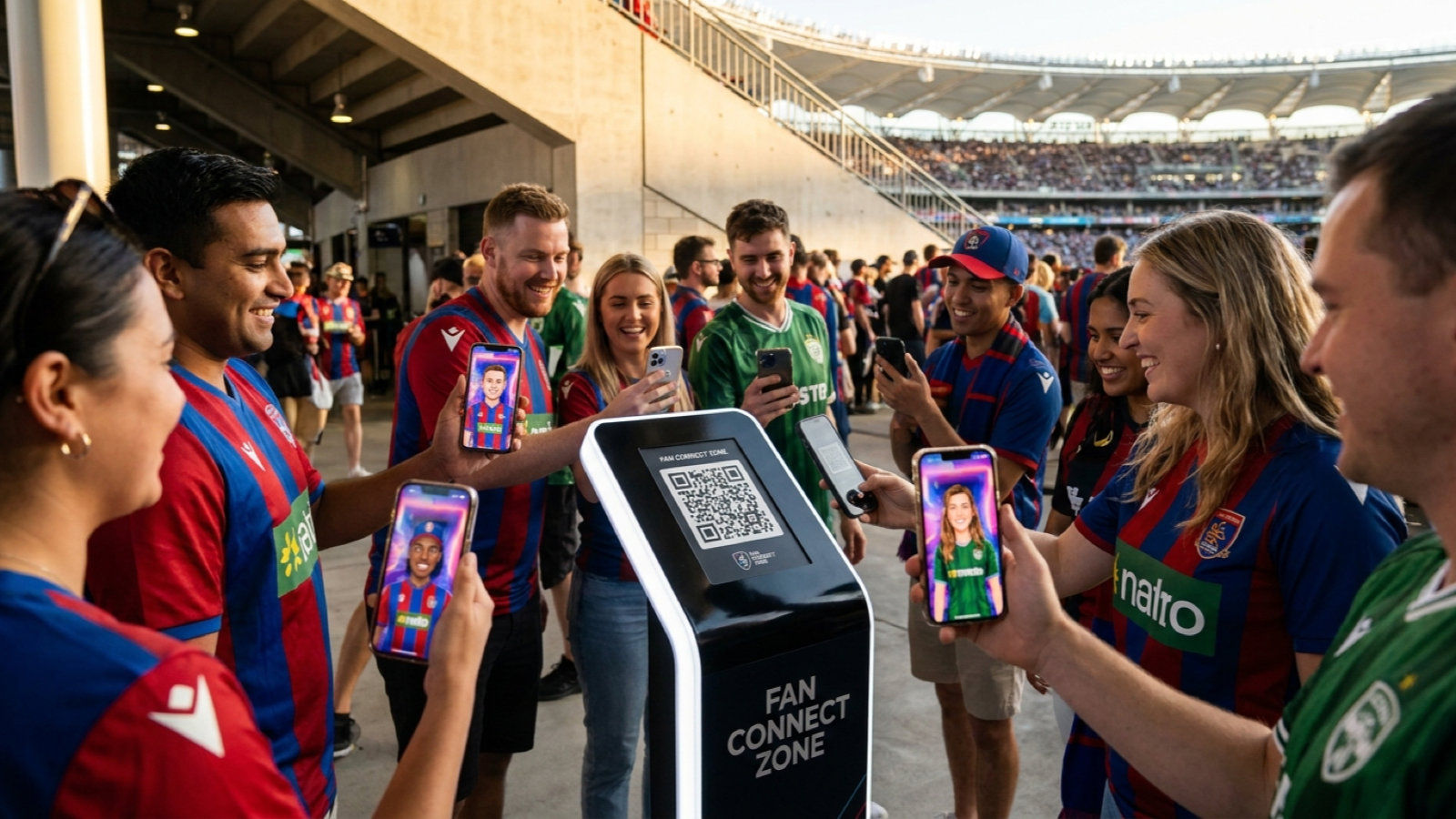
The phone-based AI photo booth model answers all three at once, because the "booth" is not a physical enclosure at all. Fans scan a QR code on the concourse, take a selfie, and receive an AI-generated image in team colours within roughly 10 seconds. There is no hardware bottleneck, so throughput scales with the crowd rather than the equipment. This is the same architecture that worked at scale in our venue-by-venue breakdown of museums, esports arenas and malls.
What an AI Photo Booth Sports Events Activation Actually Delivers
When buyers ask what they get, the honest answer has four parts:
Personalised fan content at volume. Each fan becomes the protagonist of a themed image — wearing the kit, inside the stadium, holding the trophy. The AI transformation is generated from their own selfie, so the likeness is theirs, which is exactly why they share it.
Sponsor branding embedded in the share. Event hashtag, sponsor logo and campaign frame are baked into every image before it leaves the fan's phone. Every organic share is a branded impression you can count.
A live analytics dashboard. Generation volume, sharing rate, unique users and concurrent peaks, correlated with match schedules or race times. This is the reporting layer sponsorship managers actually present internally.
Optional lead capture. Where the organiser wants it, the flow can collect an email or opt-in before delivery. For fan zones this converts a moment of joy into a CRM record — handled with the same data-privacy controls we describe in our enterprise security and privacy guide for AI photo booths.
Stadiums and Fan Zones: Designing for the Pre-Match Spike
Stadium activations live or die on the 45 minutes before the event. Design rules we apply:
No queue architecture. The phone-based flow means a fan engages standing in a concourse, at their seat, or in the external fan zone. There is nothing to queue for, which is the single biggest difference from a traditional booth.
Peak concurrency planning. At BLAST Premier Hong Kong Rivals 2025 at AsiaWorld-Arena, usage peaked at over 400 concurrent users during the grand finals. Plan capacity for the peak, not the average — the dashboard shows it live.
Moment-triggered styles. Rotate AI styles with the narrative: pre-match line-ups, half-time features, trophy-lift celebrations. A style change takes minutes and gives the crowd a reason to generate a second image.
Outdoor fan zones. External fan zones — the kind cities build around NFL London games at Wembley, where sponsors have run AI-powered fan engagement activations ahead of matches — need weather-proof signage for the QR code and staff who can steer a crowd of hundreds toward their phones rather than a single booth. For stadium-city coverage, see our London and San Francisco service pages.
Marathon Expos and Race Villages: Two Different Jobs
Marathon weekends are really two events, and they need different configurations.
The expo (two days before race day) is a dwell environment. Runners collect bibs, browse sponsor stands and have time on their hands. This is where a physical AI photo booth or a staffed selfie station works beautifully: the participant tries on their race-morning identity, generates a "tomorrow I run 42.195 km" portrait, and shares it the night before the race. Major expos such as the TCS New York City Marathon Expo presented by New Balance and the Bank of America Boston Marathon Expo draw tens of thousands of participants through partner activations across multiple days — a per-generation count at an expo is easy, high-quality volume.
The race village and finish area is a spike environment. Finishers cross the line, get their medal, and want the moment documented immediately. A phone-based flow lets the finisher generate a "I did it" portrait with the medal rendered in the AI style, while supporters in the cheer zones generate their own. Nothing physical needs to move with the crowd.
Practical notes from run weeks:
Wi-Fi at expo halls is congested; the phone flow needs a fallback network plan, and generated images should queue-and-send gracefully if connectivity dips.
Early starts mean the activation must run staff-light from 5:00 AM. Self-serve by QR code is the whole point.
Multi-language matters for international fields: elite and touring runners generate in English, Japanese, Korean, Chinese or Thai depending on the city — the same platform serves all of them.
Race Days: Horse Racing, Motorsport and Corporate Hospitality
Race days are the most corporate corner of sports events, and the buyer is often a sponsor's hospitality team rather than the venue.
At the LONGINES International Jockeys' Championship at Happy Valley in Hong Kong, PONS.ai deployed AI photo booths that gave racegoers themed, shareable portraits as part of the premium event experience — you can read the full story in our LONGINES IJC case study. The pattern generalises to any ticketed racing environment:
Hospitality suites want an exclusive-feeling momento. A private QR code and a suite-specific style set delivers that without extra hardware.
Public enclosures need throughput. Phone-based generation absorbs the mid-card lull, when the crowd is wandering and looking for something to do between races.
Watch coverage markets. For Gulf and Middle East race meetings, activations run across Arabic and English output — see our Riyadh and Abu Dhabi pages for how we structure those deployments.
Motorsport paddocks and fan zones follow the stadium model: high volume, moment-triggered styles around qualifying and the race, and sponsor branding on every share.
Sponsor Value: Making the Activation Measurable
Sponsorship managers do not get budget renewed on vibes. The four metrics that matter, all captured automatically:
Metric | What it measures | Typical reporting use |
|---|---|---|
Generations | Total fan interactions | Activation reach vs. footfall |
Shares | Organic amplification | Earned media value per share |
Unique users | Distinct participants | Cost per engaged fan |
Peak concurrency | Crowdband demand at match/race moments | Capacity and staff planning |
To make these numbers honest, define them before the event. A generation is not a booking, a share is not a qualified lead, and a blended "engagement rate" is not a replacement for the individual counts. At BLAST Premier Hong Kong Rivals 2025, the three-day activation produced more than 5,000 AI photos, over 2,800 organic shares and an estimated 150,000+ sponsor brand impressions across 3,200+ unique users — the sponsor walked into their renewal meeting with a deck, not an anecdote.
AI Photo Booth Sports Events Checklist: Power, Connectivity, Throughput
Whatever vendor you choose, walk through this checklist before signing. It is the list we use internally, and the questions it raises separate experienced providers from first-timers.
Throughput model. Ask directly: how many concurrent users, and what happens at 10x the expected peak? Physical booths cap at hardware; phone-based platforms cap at network.
Network plan. Stadium concrete and marathon crowds murder Wi-Fi. Confirm the fallback: local queuing, delayed delivery, or an independent connection.
Brand-safe style pipeline. Who designs the AI styles, who from the club or sponsor approves them, and how long does approval take? A good provider shows you the style set days before the event, not on the morning.
Rights handling. Player likenesses and club marks are licensed. The provider should generate original themed art in approved colours, not scrape imagery — and should say so in writing.
Data and privacy. Where do selfies go, how long are they retained, and is lead capture opt-in? Our enterprise security and privacy guide covers the standard we hold ourselves to.
Staffing and setup. Phone-based activations need signage, a few roving staff and a dashboard login — not a truck. Setup is measured in hours, and there is no load-in constraint on stadium freight lifts.
Weather. Outdoor fan zones need printed QR codes that survive rain and signage readable in sun. Cheap laminated A4 dies by mid-afternoon.
Reporting deadline. Agree when the analytics report lands — sponsors want it within days of the event, while the numbers are still decision-relevant.
AI Photo Booth vs Traditional Fan-Zone Photo Options at a Glance
AI photo booth (PONS.ai, phone-based) | Traditional enclosed photo booth | Green-screen / photographer | |
|---|---|---|---|
Throughput | Scales with crowd; 400+ concurrent observed | Hardware-capped; long queues at peaks | One group per photographer |
Personalisation | AI transformation per fan, per style | Static props and frame | Composite backdrop, no likeness work |
Sponsor data | Generations, shares, users, peaks, live dashboard | Print counts only | Photo counts at best |
Queue | None — fans use their own phones | Physical queue, visible and off-putting | Same as booth |
Setup | Hours; signage + staff | Freight, power, space allocation | Photographer + kit |
Moment coverage | Anywhere on concourse, fan zone or suite | Fixed location | Fixed location |
What PONS.ai Has Actually Delivered at Sports and Fan Events
We name real clients because we have real case studies:
BLAST Premier Hong Kong Rivals 2025 — Counter-Strike 2 at AsiaWorld-Arena: 5,000+ AI photos, 2,800+ organic shares, 400+ peak concurrent users during the grand finals, 150,000+ estimated sponsor impressions. Full write-up: how PONS.ai brought AI photo booths to gaming.
LONGINES International Jockeys' Championship — premium race-day engagement at Happy Valley, Hong Kong, as covered in our LONGINES IJC case study.
Sandbox VR — immersive entertainment audiences, where AI gamer postcards turned a VR session into shareable UGC.
PONS.ai was founded by Kelvin Tang and has delivered millions of AI-generated images for enterprise brands since 2021. Where we have not yet run an event in a city, we say so — what travels is the platform and the playbook, and our AI photo booth hub page lists every market we currently serve.
What Does an AI Photo Booth for Sports Events Cost?
Honest answer: sports-event pricing is quoted per activation, because the variables — event days, expected fan volume, number of custom AI styles, staff presence, analytics and lead-capture requirements, and travel — swing the number more than any rate card. Vendors that publish flat sports packages online are usually pricing the hardware, not the crowd. Ask two or three providers, including us, for a scoped quote with the checklist above attached; if a quote cannot explain what drives its own number, that tells you something. We do not publish competitor prices here because verified public pricing for this category is generally not published.
Frequently Asked Questions
How does an AI photo booth work at a stadium or fan zone?
Fans scan a QR code, take a selfie on their own phone, and receive an AI-generated image in approved team and sponsor styles in about 10 seconds. There is no physical enclosure, so there is no queue and throughput scales with the crowd.
How many fans can an AI photo booth handle at a big match?
At BLAST Premier Hong Kong Rivals 2025 we observed over 400 concurrent users during the grand finals and 5,000+ generations across three days. Because delivery is phone-based, capacity is planned for the peak rather than capped by hardware.
Can AI photo booth styles include our team's kit and sponsor branding?
Yes, within rights limits. We design original themed artwork in approved team colours and embed sponsor marks and the event hashtag in the share frame. Licensed player likenesses and club marks are used only with the rights holder's approval.
Do AI photo booths work outdoors at marathons and race villages?
Yes. The phone-based flow has no hardware to shelter, so the outdoor requirements are practical: weather-proof QR signage, a network fallback plan and staff-light operation for early starts.
How far in advance should we book for a match or race day?
Custom style design and rights approval are the long-lead items. For a single match day, four to six weeks is comfortable; for a marathon weekend or a multi-day tournament with sponsor sign-off, plan eight weeks or more. Tight timelines are sometimes workable — ask us early rather than late.
Do fans need to download an app?
No. The experience runs in the phone's browser from a QR code, which is what makes spike-hour throughput possible.
Can we capture leads from a fan-zone activation?
Yes, optionally. Opt-in email capture can be added before image delivery, and the analytics dashboard reports generations, shares, unique users and peaks. Form opt-ins are engagement data, not qualified bookings — we report them as what they are.
Which cities does PONS.ai cover for sports events?
We serve activations across our current market pages, including London, New York, San Francisco, Singapore, Tokyo, Dubai, Abu Dhabi and Riyadh, with our home delivery team in Hong Kong. Multi-city roadshow structures are covered in our multi-city roadshow guide.
Book a demo with PONS.ai


Comments